
Languages
IT Japanese: Pass Technical Interviews in Japanese

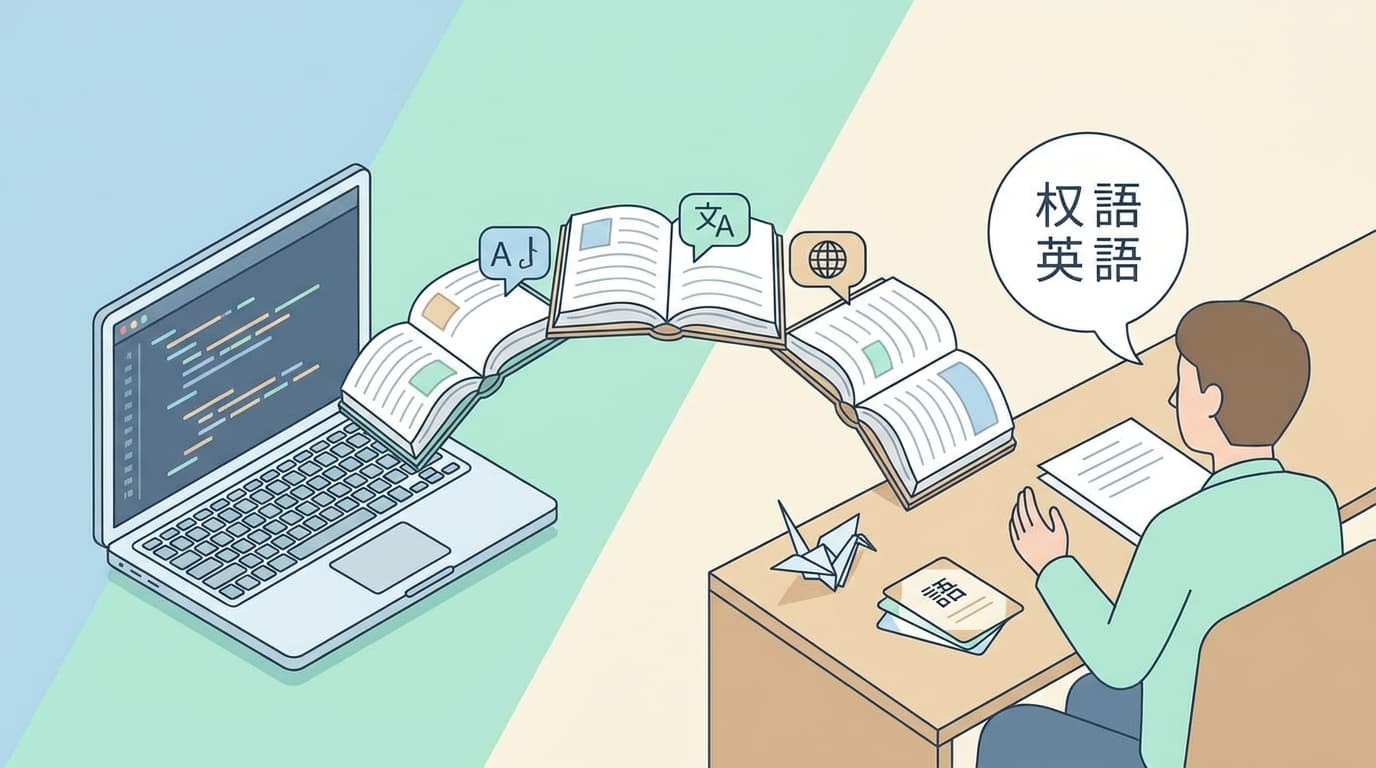
IT Japanese: How to Pass Technical Interviews in Japanese
Technical interviews in Japanese combine two hard skills at once: engineering knowledge and business-level Japanese. This guide gives you the exact vocabulary, phrases and practice routine to handle both.
Most learners fail not because they can't code, but because they freeze when asked to explain their design in Japanese. The fix is repetition with real material. On Corodomo you can paste a YouTube link to a Japanese tech talk or mock interview and get bilingual subtitles automatically. Then you look up every unknown word with the AI dictionary, practise pronunciation with CoroAI, and drill the terms with flashcards and quizzes. That turns passive watching into interview-ready output.
- Why IT Japanese Is Different From Everyday Japanese
- Core IT Vocabulary You Must Recognise Instantly
- Keigo for Interviews: The Polite Patterns That Matter
- Answer Templates: Self-Introduction, Projects and Failures
- Talking Through Code and System Design in Japanese
- A 4-Week Practice Routine That Actually Works
- FAQ
- Conclusion
Why IT Japanese Is Different From Everyday Japanese
Everyday Japanese taught in textbooks is built around daily life: ordering food, asking directions, chatting about hobbies. IT Japanese is built around precision. In an interview, vague language reads as vague thinking. You need words like 冗長 (jōchō – redundant), 排他制御 (haita seigyo – exclusive locking) and 可用性 (kayōsei – availability) to explain trade-offs clearly.
The second difference is register. Interviewers expect です・ます (desu/masu) polite form throughout, plus a layer of business keigo when you talk about your company, your manager or your past work. Casual forms that are fine with friends sound careless in a hiring context.
The third difference is code-switching. Japanese engineers constantly mix English loanwords with native terms: デプロイ (depuroi – deploy), リファクタリング (rifakutaringu – refactoring), バグ (bagu – bug). You do not need to translate these into Japanese. You need to pronounce them naturally and use them in the right context.
- Learn IT terms in Japanese script first, not romaji. Reading 本番環境 (honban kankyō – production environment) at a glance saves seconds in a live interview.
- Collect words from real sources: Japanese tech blogs, conference talks, GitHub issues written in Japanese.
- Separate passive vocabulary (you understand it) from active vocabulary (you can say it under pressure). Interviews only reward active.
- Practise saying each term out loud five times. Recognition is not enough.
可用性 (kayōsei) – availability · 冗長化 (jōchōka) – making redundant · 障害 (shōgai) – incident/failure
Core IT Vocabulary You Must Recognise Instantly
Aim for roughly 300 active IT words before your first Japanese-language interview. That sounds like a lot, but the list is highly repetitive. The same 100 terms appear in almost every backend, frontend or infrastructure interview.
Group words by theme so your brain retrieves them in clusters. When an interviewer asks about パフォーマンス (pafōmansu – performance), you want 遅延 (chien – latency), スループット (surūputto – throughput) and ボトルネック (botorunekku – bottleneck) to arrive together, not one by one.
Pay special attention to words with kanji you can decompose. 保守 (hoshu – maintenance) and 運用 (un'yō – operations) are different jobs, and interviewers notice when you use them correctly. If you are building Japanese reading speed, the Japanese dictionary on Corodomo lets you look up a word mid-video without losing your place.
| Japanese | Reading | Meaning |
|---|---|---|
| 要件定義 | yōken teigi | requirements definition |
| 設計 | sekkei | design |
| 実装 | jissō | implementation |
| 試験 | shiken | testing |
| 本番環境 | honban kankyō | production environment |
| 検証環境 | kenshō kankyō | staging/verification environment |
| 障害対応 | shōgai taiō | incident response |
| 改修 | kaishū | modification/refactoring work |
- Build a themed list per week: databases, networking, CI/CD, security, testing.
- Write each word with its kanji, reading and one full sentence of your own.
- Use spaced repetition. Corodomo's leveled vocabulary and four test types (meaning, listen-and-type, type the reading, write a sentence) cover all four skills.
- Record yourself saying the word, then compare with a native speaker in a video.
Keigo for Interviews: The Polite Patterns That Matter
You do not need perfect keigo to pass. You need a small set of patterns used flawlessly. Interviewers forgive simple grammar; they do not forgive rudeness or confusion about who did what.
The core is humble vs. respectful. When you talk about your own actions, use humble forms: いたします (itashimasu – I will do), 担当しました (tantō shimashita – I was in charge of), 拝見しました (haiken shimashita – I read/looked at). When you talk about the interviewer's company or people, use respectful forms: ご覧になる (goran ni naru – to look), いらっしゃる (irassharu – to be/go/come).
One trap for English speakers: over-apologising. In English, "sorry, I'm not sure" is normal hedging. In a Japanese interview, すみません (sumimasen) repeated too often sounds unsure. Use 申し訳ありません (mōshiwake arimasen) once, then pivot to what you do know.
「前職では決済システムの運用を担当しておりました。」
Zenshoku de wa kessai shisutemu no un'yō o tantō shite orimashita.
At my previous company, I was in charge of operating a payment system.
- Memorise three humble verbs for your own actions and use them consistently.
- Use 〜ております (te orimasu) instead of 〜ています (te imasu) in formal self-description.
- Replace 思います (omoimasu – I think) with と考えております (to kangaete orimasu – I consider) for opinions.
- Practise the opening and closing of the interview until they are automatic.
Answer Templates: Self-Introduction, Projects and Failures
Japanese interviews follow a predictable script. If you prepare structured answers, you spend your mental energy on content instead of grammar. The classic self-introduction is 自己紹介 (jikoshōkai), and it should run about 60–90 seconds.
Use a simple four-part structure: current role, years and domain, one concrete achievement with a number, and why this company. Numbers are your friend: 三人チーム (san-nin chīmu – a three-person team), 応答時間を40%削減 (ōtō jikan o 40% sakugen – reduced response time by 40%).
The failure question (失敗した経験 – shippai shita keiken) is where many candidates stumble. Answer with the STAR pattern in Japanese: 状況 (jōkyō – situation), 課題 (kadai – task), 行動 (kōdō – action), 結果 (kekka – result). Always end with what you changed afterwards.
| Question | Japanese | Your structure |
|---|---|---|
| Tell me about yourself | 自己紹介をお願いします | role → domain → achievement → motivation |
| Your toughest project | 一番大変だったプロジェクトは? | situation → constraint → your action → result |
| A failure | 失敗した経験を教えてください | STAR + lesson + later fix |
| Why this company | 志望動機を教えてください | their product → your skill → mutual fit |
- Write each answer in Japanese, then cut it by 30%. Spoken answers should be shorter than written ones.
- Record yourself and count filler words like えーと (ēto – um).
- Prepare two versions of each story: a 30-second and a 90-second version.
- Reuse vocabulary from the job posting. It signals you read it carefully.
Talking Through Code and System Design in Japanese
Many Japanese technical interviews include a live coding or whiteboard segment. The code itself may be language-agnostic, but your narration is in Japanese. Silence is the biggest mistake. Interviewers want to hear your reasoning, even when it is incomplete.
Learn a small set of narration phrases and reuse them constantly: まず (mazu – first), 次に (tsugi ni – next), ここで (koko de – here), つまり (tsumari – in other words), 計算量は (keisanryō wa – the computational complexity is). These buy you thinking time while sounding organised.
For system design, master the trade-off vocabulary. Saying 「可用性を優先すると、コストが上がります」 (kayōsei o yūsen suru to, kosuto ga agarimasu – prioritising availability raises cost) shows engineering maturity in one sentence.
If you are preparing for a role where you will read Japanese documentation daily, build the habit now. On Corodomo you can upload a recorded mock interview, generate bilingual subtitles, then use the AI Q&A to ask what the interviewer meant by a specific phrase. The work-related word pages are also useful for the business vocabulary that surrounds engineering talk.
「この実装だと、データ量が増えたときに遅くなる可能性があります。」
Kono jissō da to, dēta ryō ga fueta toki ni osoku naru kanōsei ga arimasu.
With this implementation, it may become slow when the data volume grows.
- Narrate every practice problem out loud in Japanese, even alone.
- Prepare five trade-off sentences you can deploy in any design question.
- Ask clarifying questions in Japanese: 「前提条件を確認してもいいですか」 (I'd like to confirm the assumptions).
- When stuck, say 「少し考えさせてください」 (let me think for a moment) instead of going silent.
A 4-Week Practice Routine That Actually Works
Four weeks is enough to move from "I understand IT Japanese" to "I can interview in it" if you practise output daily. The key is volume of speaking, not volume of reading.
Week one: vocabulary sprint. Build 250 IT terms with readings and example sentences. Use Corodomo's flashcards and the four vocabulary tests to make recall automatic. Week two: answer writing. Draft and record your self-introduction, three project stories and one failure story.
Week three: listening and shadowing. Watch Japanese tech talks or interview videos with bilingual subtitles, then shadow the speaker line by line. CoroAI's pronunciation practice is designed exactly for this loop. Week four: full simulations. Run two mock interviews per week, record them, and review the transcript for filler words and grammar slips.
| Week | Focus | Daily time | Output goal |
|---|---|---|---|
| 1 | IT vocabulary | 30 min | 250 active terms |
| 2 | Answer scripts | 40 min | 5 recorded answers |
| 3 | Listening + shadowing | 40 min | 10 shadowed clips |
| 4 | Mock interviews | 50 min | 6 full simulations |
- Speak every day, even for ten minutes. Consistency beats long weekend sessions.
- Keep a running error log and review it before each mock interview.
- Use video summaries and quizzes to check you understood a talk, not just heard it.
- Simulate pressure: set a timer and answer without notes.
FAQ
What JLPT level do I need for a Japanese technical interview?
Most companies ask for N2 or above, and N1 helps for client-facing roles. That said, interviewers care more about fluent technical explanation than a certificate. Many engineers pass interviews at N2 level because their IT vocabulary and speaking practice are strong.
Can I use English technical terms during a Japanese interview?
Yes, and you should. Terms like デプロイ, リポジトリ and フレームワーク are standard in Japanese workplaces. The risk is using English for concepts that have common Japanese equivalents, such as 要件定義 or 障害対応. Learn which is which.
How do I practise speaking Japanese for interviews if I have no partner?
Record yourself answering standard questions, then review the recording. Shadowing native speakers in tech videos also builds fluency fast. Tools like CoroAI let you compare your pronunciation and repeat difficult lines until they feel natural.
Should I memorise full answers word for word?
Memorise the structure and key phrases, not the whole script. Word-for-word answers sound robotic and collapse when the interviewer asks a follow-up. Prepare bullet points in Japanese and practise speaking from them.
How long does it take to prepare for an IT interview in Japanese?
If you are already around N3–N2, four to eight weeks of daily practice is a realistic estimate for many learners. If your general Japanese is below N3, plan several months and prioritise listening and speaking first.
Conclusion
Passing a technical interview in Japanese is a learnable skill, not a talent. First, build a focused active vocabulary of around 300 IT terms grouped by theme, so words arrive in clusters under pressure. Second, master a small set of keigo patterns and answer templates rather than trying to perfect all of keigo. Third, practise output daily through recording, shadowing and full mock interviews.
If you want to speed up the listening and vocabulary side, try turning real Japanese tech videos into study material. Corodomo generates bilingual subtitles, gives you detailed AI word lookups, pronunciation practice with CoroAI, flashcards and four vocabulary tests — all in one loop. If you are also strengthening your general Japanese, the study-related word page and the 勉 and 学 kanji pages are a good place to start.
Try Corodomo: Learn languages · Learn via Video · Exam practice