
Languages
Chinese Listening Practice: Dictation to Break Plateau

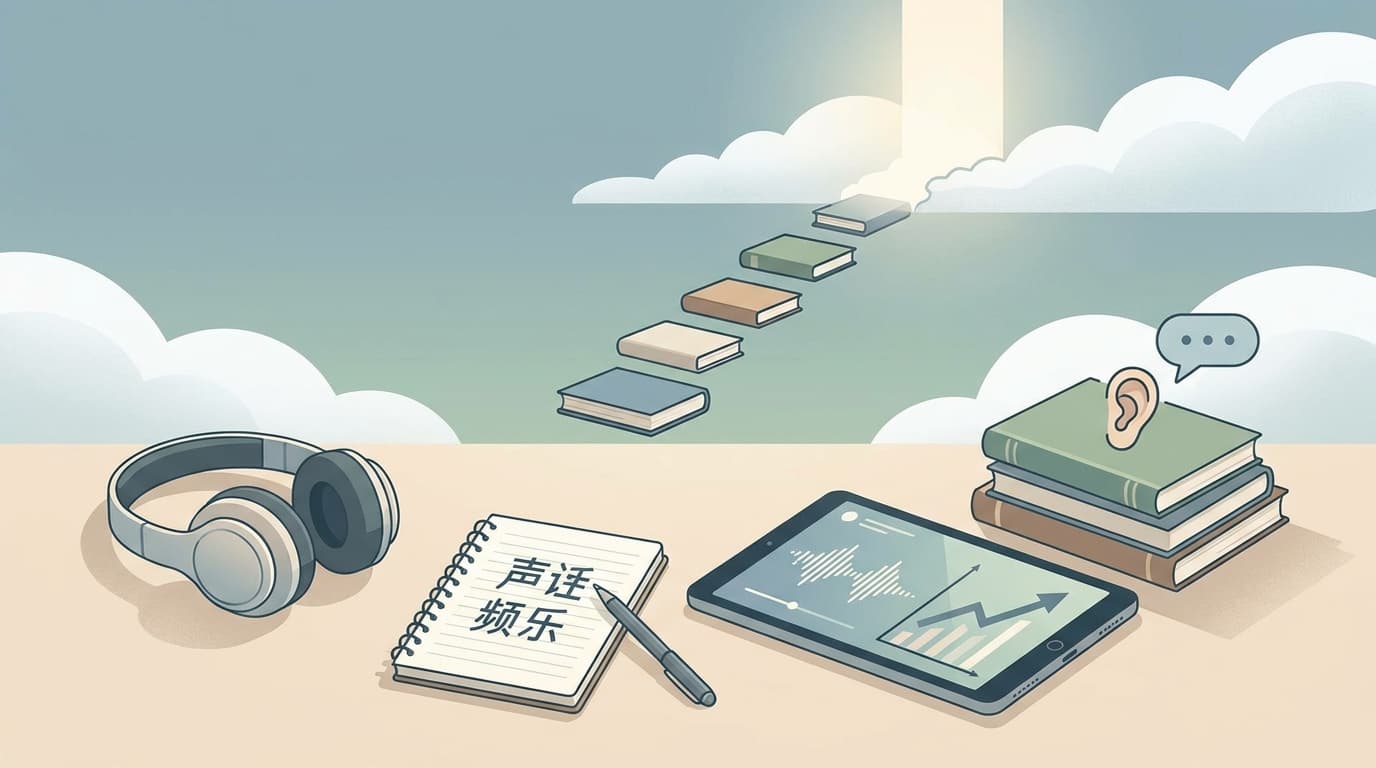
Chinese Listening Practice: Dictation Method to Break the Intermediate Plateau
You can read a menu, chat with a tutor, and still miss half of a fast conversation. The dictation method turns that fuzzy listening into measurable progress.
Most intermediate learners plateau because they listen passively. They play a podcast, catch the gist, and move on. Nothing gets checked, so nothing gets fixed. Dictation flips that: you write down exactly what you hear, then compare it with the real text. Every mistake becomes a specific, fixable problem — a tone you misheard, a word boundary you missed, or a sound change you never noticed. Tools like Corodomo make this loop fast: paste a YouTube link or upload your own video, and it auto-generates bilingual subtitles you can hide, reveal, and rewind line by line. You also get AI word lookup, quizzes, and flashcards from the same clip, so one video becomes a full study session instead of background noise.
- Why intermediate listening stalls (and why dictation works)
- The 6-step dictation routine
- Hearing tones and tone changes in real speech
- Handling natural speed, reductions, and 了 / 过 / 着
- Choosing the right video material
- A 20-minute daily schedule that fits a busy life
- FAQ
- Conclusion
Why intermediate listening stalls (and why dictation works)
At the beginner stage, you decode sounds one by one. At the intermediate stage, you start predicting. Prediction is efficient, but it hides gaps. You hear 我觉得这个想法不错 and your brain fills in the rest from context, even if you missed 想法 entirely. That feels like understanding, but it is guessing.
Dictation removes the escape hatch. You must produce the exact characters, which forces your ear to resolve every syllable. If you cannot write it, you did not hear it. This is uncomfortable, and that discomfort is the point: it surfaces the specific sounds and patterns you have been skipping for months.
The second reason is feedback speed. Passive listening gives you no score. Dictation gives you an immediate, objective one: correct lines, missing words, wrong tones. When you use Corodomo, you can hide subtitles while typing, then reveal the bilingual line to check yourself. The gap between attempt and correction shrinks to seconds, which is exactly how listening accuracy improves fastest.
- Stop re-listening to content you already understand well; it feels good but teaches little.
- Pick clips 30–90 seconds long. Longer clips create fatigue, not progress.
- Write in characters, not pinyin. Pinyin lets you hide tone and homophone errors.
- Count your errors per line. Track the number, not your mood.
Example line: 我明天要去上班。
Wǒ míngtiān yào qù shàngbān. – "I have to go to work tomorrow."
Common miss: writing 上班 (shàngbān, "go to work") as 上边 (shàngbian, "on top") because the final -n is swallowed.
The 6-step dictation routine
This routine takes 15–25 minutes per clip. Do it in the same order every time so it becomes automatic. The sequence matters: listen first without text, then type, then check, then repair.
Step 1 — Blind listen. Play the clip twice with no subtitles. Do not write yet. Just note the topic, the speaker's mood, and any words that jump out. This primes your ear without pressure.
Step 2 — Dictate line by line. Play one sentence, pause, and type what you heard in Chinese characters. If you need a third replay, allow it, but mark that line with a star. Stars show where your listening breaks down.
Step 3 — Check against the real text. Reveal the subtitles and compare word by word. Mark three error types: wrong word, missing word, wrong tone. Use different colors or symbols so patterns appear over a week.
Step 4 — Repair each error out loud. Say the correct sentence aloud three times, matching the speaker's rhythm. Reading silently does not fix a listening error; your mouth has to learn the sound too.
Step 5 — Shadow the clip. Play the audio and speak along, half a second behind. This builds the timing that makes fast speech feel normal. Corodomo's pronunciation practice with CoroAI is useful here, since you can repeat a line and get feedback on your own tones.
Step 6 — Convert errors into review cards. Every starred line becomes a flashcard. In Corodomo, the leveled vocabulary and flashcard system pulls words straight from the video, and the four vocabulary tests (choose the meaning, listen and type, type the reading, write an example sentence) turn those errors into active recall instead of passive re-reading.
- Never skip Step 1. Blind listening trains prediction; skipping it makes dictation mechanical.
- Cap replays at three per line. More than that means the clip is too hard — pick easier material.
- Keep an error log with date, clip, and error type. Review it every Sunday.
- Finish each session by re-listening to the whole clip once with subtitles off. The ending should feel easy.
| Chinese | Pinyin | Meaning |
|---|---|---|
| 听写 | tīngxiě | dictation |
| 字幕 | zìmù | subtitles |
| 重听 | chóngtīng | to listen again |
| 语速 | yǔsù | speaking speed |
Hearing tones and tone changes in real speech
Tones are the number one reason intermediate learners mishear Chinese. In isolation you know that 买 (mǎi, "buy") and 卖 (mài, "sell") differ. In a fast sentence, that difference can vanish unless you have trained your ear on real audio.
Start by dictating with tone marks included. Write mǎi, not mai. Then check whether your tone matches the speaker's. Most learners discover they hear the syllable correctly but assign the wrong tone, especially on second and fourth tones in unstressed positions.
Next, train tone sandhi. When two third tones meet, the first becomes second: 你好 is written nǐ hǎo but spoken ní hǎo. When 不 (bù) precedes a fourth tone, it becomes bú: 不是 becomes bú shì. Dictation exposes these because your written pinyin will look wrong next to the audio.
Finally, watch for neutral tones. In 东西 (dōngxi, "thing"), the second syllable loses its tone. Learners often write dōngxī and then wonder why the audio sounded different. Mark neutral tones in your transcript with a dot so they stand out in review.
- Dictate 10 minutes of tone-focused audio per week, separate from your normal clips.
- Always write pinyin with tone marks during dictation, even if you type characters.
- Record yourself reading your transcript, then compare with the original audio.
- Keep a list of tone pairs you consistently miss (for example, 2nd + 3rd) and drill them.
Example pair: 我在学习中文。
Wǒ zài xuéxí Zhōngwén. – "I am studying Chinese."
Learners often hear 学习 (xuéxí, "to study") as 学西 (xué xī) because the second syllable is quick and unstressed in fast speech.
Handling natural speed, reductions, and 了 / 过 / 着
Real Mandarin is not just fast; it is compressed. Speakers merge syllables, drop finals, and reduce grammatical markers. If your study audio is slow and clean, real conversation will always feel impossible.
One common trap is the aspect markers 了 (le), 过 (guò), and 着 (zhe). They are short, unstressed, and easy to miss. In 我吃了饭 (Wǒ chī le fàn, "I ate"), the 了 can almost disappear. In 我去过北京 (Wǒ qù guo Běijīng, "I have been to Beijing"), 过 sounds like a light "gwo." Dictation forces you to decide whether you heard it or not, and that decision trains attention.
Another trap is numbers and measure words. 三百二十 (sān bǎi èr shí, "three hundred twenty") can blur into one sound stream. Dictate news clips and vlogs with prices, dates, and times. Numbers are high-frequency and give you instant right-or-wrong feedback.
To build speed tolerance, use a two-pass method. First pass at 0.75x speed to capture structure. Second pass at full speed to catch what you missed. Over weeks, move the first pass to 0.9x, then 1.0x. Corodomo's video player makes this easy because the subtitles stay synced while you slow the audio down.
- Dictate one clip per week that contains numbers, dates, or prices.
- Mark every 了, 过, and 着 you hear, even if you are unsure. Then verify.
- Use 0.75x only as training wheels. Full speed must stay in the routine.
- After dictating, summarize the clip in two Chinese sentences. This checks comprehension, not just transcription.
| Spoken form | Pinyin | Meaning |
|---|---|---|
| 我吃了饭 | Wǒ chī le fàn | I ate (completed action) |
| 我去过北京 | Wǒ qù guo Běijīng | I have been to Beijing |
| 他笑着说 | tā xiào zhe shuō | he said, smiling |
Choosing the right video material
The biggest mistake at the intermediate level is choosing material that is either too easy or too hard. Too easy feels productive but teaches nothing. Too hard destroys motivation within a week. You want roughly 85–95% comprehension before dictation, so the unknown parts are learnable.
Good sources include short interviews, cooking videos, product reviews, and vlogs with clear speech. Avoid heavily scripted dramas at first — the emotional delivery and background music make dictation brutal. Once you handle interviews comfortably, move to sitcoms and news segments.
Length matters more than topic. A 45-second clip you fully dictate beats a 20-minute podcast you half-listen to. With Corodomo, you can paste a YouTube link and get bilingual subtitles instantly, then use the video summary and AI Q&A to confirm you understood the main points before you start dictating details.
- Pick clips with one or two speakers and minimal background noise.
- Prefer content you actually enjoy; you will replay it many times.
- Rotate topics weekly: daily life, work, news, culture.
- Keep a folder of "passed" clips. Re-dictate one after a month to measure progress.
Sample mini-task: choose a 60-second vlog about cooking. Dictate it fully. Count errors. Then re-dictate the same clip 30 days later and compare the error count. Most learners see a clear drop — an estimate, but a motivating one.
A 20-minute daily schedule that fits a busy life
Consistency beats intensity. Twenty focused minutes a day will outperform a three-hour weekend session, because listening accuracy is a skill built through repetition, not marathon effort.
A simple split: 5 minutes blind listening and line-by-line dictation, 5 minutes checking and repairing errors, 5 minutes shadowing aloud, and 5 minutes turning errors into flashcards or quizzes. If you only have 10 minutes, do dictation and checking — skip shadowing, but never skip the correction step.
Track two numbers weekly: total minutes dictated and errors per minute of audio. If errors per minute falls, you are improving even when progress feels invisible. If it stalls for two weeks, change material rather than pushing harder on the same clip.
- Same time, same place. Habit beats motivation.
- Keep one clip per day, not five. Depth over volume.
- Review your error log every Sunday and pick next week's focus.
- Use Corodomo's quizzes and flashcards on days when you are too tired to dictate.
FAQ
How long does it take to break the intermediate listening plateau?
With 20 minutes of dictation five days a week, most learners notice clearer comprehension of fast speech within 6–10 weeks. This is an estimate based on typical self-study patterns, not a guarantee. Progress depends on material difficulty and how carefully you correct errors.
Should I write in pinyin or Chinese characters during dictation?
Write characters if you can, and always add pinyin with tone marks. Characters force you to distinguish homophones, while pinyin exposes tone errors. If characters slow you down too much, start with pinyin for a week, then switch.
Is it better to dictate with or without subtitles?
Dictate without subtitles first, then reveal them to check. If you read subtitles while listening, you are practicing reading, not listening. Use subtitles only as an answer key.
What if the audio is too fast to dictate at all?
Slow it to 0.75x and dictate the structure first. Then replay at full speed and fill in what you missed. If you still cannot catch more than half, the clip is too hard — choose easier material for a week.
Can I use dictation for Korean, Japanese, or German too?
Yes. The method works for any language: listen, transcribe, compare, repair. Corodomo supports Japanese, Chinese, English, Korean, and German, so you can apply the same bilingual subtitle and quiz workflow across languages.
Conclusion
The intermediate plateau is not a talent problem; it is a feedback problem. Dictation solves it by turning vague listening into measurable errors you can fix one by one.
Three key points to remember. First, always dictate without subtitles and check afterward — that gap is where learning happens. Second, track error types (wrong word, missing word, wrong tone) instead of just replaying audio. Third, keep clips short and sessions daily; 20 focused minutes beats an occasional marathon.
Start today with one 60-second clip. Dictate it, check it, and log your errors. Then repeat tomorrow. If you want the whole loop in one place — bilingual subtitles, AI word lookup, pronunciation practice, and vocabulary tests built from your own videos — try Corodomo and let one video do the work of a full lesson.
Try Corodomo: Learn languages · Learn via Video · Exam practice