
Languages
JLPT N5 to N1 Roadmap: Real Time to Fluency

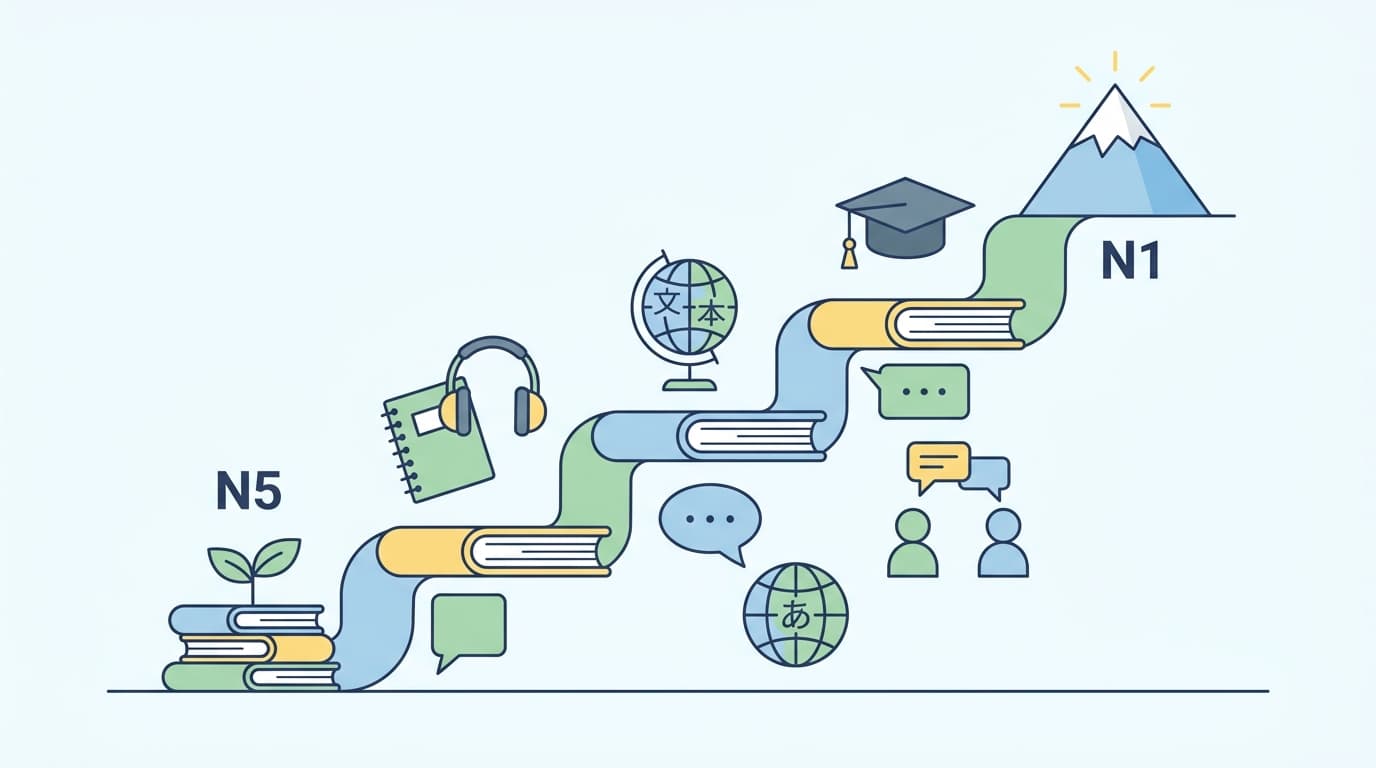
Complete JLPT N5 to N1 Roadmap: How Long It Really Takes
Most learners quit Japanese because nobody tells them how long the road really is. This JLPT N5 to N1 roadmap gives you honest timelines and a level-by-level plan you can actually follow.
The question "how long does JLPT take?" has a real answer, and it is not "a few months." The Japan Foundation and JLPT organizers publish approximate study-hour estimates for each level, and they are sobering: N5 is a few hundred hours, N1 is several thousand (estimates vary by source and by your native language). The good news is that the path is well mapped. You do not need talent, and you do not need to live in Japan. You need a sequence, a daily habit, and the right tools. That is where Corodomo fits in: it is a video-based language platform where you paste a YouTube link or upload a video, and it auto-generates bilingual subtitles. From there you can look up any word with detailed AI definitions, practice pronunciation with CoroAI, drill pinyin typing and dictation, and run quizzes, video summaries, flashcards, and four vocabulary tests. It supports Japanese, Chinese, English, Korean, and German — so the same workflow carries you from N5 all the way to N1.
- How long JLPT really takes: the honest numbers
- N5 and N4: building the base
- N3: the wall every learner hits
- N2 and N1: from functional to fluent
- A weekly schedule for busy self-learners
- Common mistakes that add years
- FAQ
- Conclusion
How long JLPT really takes: the honest numbers
The JLPT has five levels. N5 and N4 test basic understanding, N3 is a bridge level, and N2 and N1 test comprehension of real materials like news, essays, and workplace documents. The jump between levels is not linear — N4 to N3 is a bigger leap than N5 to N4, and N2 to N1 is the biggest of all.
Rough study-hour estimates for learners with no kanji background (these are approximations, not guarantees) look like this: N5 around 350–450 hours, N4 around 700–900 cumulative, N3 around 1,500–1,800 cumulative, N2 around 2,500–3,000 cumulative, and N1 around 4,000–5,000+ cumulative. Someone studying one focused hour a day reaches N5 in under a year, but N1 in roughly a decade at that pace.
Do not panic at those numbers. They assume classroom-style hours that include a lot of inefficiency. A self-learner who studies smart — with spaced repetition, real video input, and active output practice — often moves faster, especially in the early levels. The key variable is not raw hours but hours multiplied by quality of feedback.
That is exactly why a tool like Corodomo matters early. Instead of grinding vocabulary lists without context, you watch a short video, read the bilingual subtitles, tap a word for an AI explanation, then test yourself on it. Context plus retrieval is the fastest known combination for retention.
- Track hours, not days. A calendar month means nothing; 40 focused hours means something.
- Set a target level and a target exam date, then work backward to weekly hours.
- Expect the hours per level to grow, not shrink. N2 and N1 need more input, not more flashcards.
- Reassess every three months. If you have not moved, change method, not motivation.
| Level | Approx. cumulative hours | Typical pace at 1 hr/day |
|---|---|---|
| N5 | 350–450 | 10–14 months |
| N4 | 700–900 | 2–2.5 years |
| N3 | 1,500–1,800 | 4–5 years |
| N2 | 2,500–3,000 | 7–8 years |
| N1 | 4,000–5,000+ | 10+ years |
N5 and N4: building the base
N5 is where you learn that Japanese is a system, not a pile of phrases. You need hiragana and katakana cold, roughly 100–150 kanji, around 800 vocabulary words, and basic grammar: particles, polite verb forms, past tense, and simple requests. N4 doubles most of that — roughly 300 kanji and 1,500 words — and adds te-form chains, conditional forms, and passive basics.
The single most common N5 mistake is studying kanji as isolated shapes. Learn them inside words. The kanji 勉 rarely appears alone; it shows up in 勉強 (benkyou – study), which is one of the first words you will actually use. Similarly, 学 (gaku – study, learning) appears in 学生 (gakusei – student) and 大学 (daigaku – university). Learning the character with two or three real words attached makes it stick.
At N4, start watching short authentic videos with subtitles. You will not understand most of it, and that is fine. The goal is to train your ear to sentence rhythm while your vocabulary catches up. Use a tool that gives you bilingual subtitles so you can check meaning instantly instead of pausing to open a dictionary.
仕事 (shigoto) – work, job
毎日、仕事に行きます。(Mainichi, shigoto ni ikimasu.) – I go to work every day.
For quick lookups while reading, a dedicated Japanese dictionary tool is far faster than a browser search. Keep it open in a second tab during every study session.
- Finish kana in the first two weeks. Do not "sort of" know them.
- Learn 10–15 new words a day with example sentences, not bare translations.
- Write kanji by hand for the first 300. Muscle memory helps recognition.
- Read every example sentence out loud. Silent reading hides pronunciation gaps.
- Take a mock N5 or N4 test every two months to calibrate.
| Word | Reading | Meaning |
|---|---|---|
| 勉強 | benkyou | study |
| 仕事 | shigoto | work, job |
| 学生 | gakusei | student |
| 毎日 | mainichi | every day |
N3: the wall every learner hits
N3 is where the JLPT stops being a vocabulary test and becomes a comprehension test. You need roughly 650 kanji and 3,700 vocabulary words, plus the ability to follow a paragraph and infer meaning from context. This is the level where most self-learners stall for a year or more.
The reason is simple: N3 materials are the first ones that are not written for learners. Graded readers end, textbook dialogues feel fake, and real articles assume cultural knowledge you do not have yet. The fix is volume. You need to read and listen to a lot of slightly-too-hard material, and you need a fast way to resolve unknown words without breaking flow.
Video is ideal here. A five-minute news clip or vlog gives you natural speed, natural particles, and real intonation. With bilingual subtitles you can watch once for gist, once with subtitles for detail, then again without subtitles to test yourself. Corodomo's AI Q&A that understands the video is useful at this stage: ask it why a character used a particular form, and you get an answer tied to what you just watched.
天気 (tenki) – weather
明日の天気はどうですか。(Ashita no tenki wa dou desu ka.) – How is tomorrow's weather?
- Read one short article or watch one short video daily, even on busy days.
- Keep a "known unknown" list: words you recognize but cannot define. Review weekly.
- Shadow audio for two minutes per session. Copy rhythm, not just sounds.
- Start timed reading. N3 punishes slow readers more than weak vocabulary.
- Do not restart a textbook. Add input instead.
| Level | Kanji (approx.) | Vocabulary (approx.) |
|---|---|---|
| N5 | 100–150 | 800 |
| N4 | 300 | 1,500 |
| N3 | 650 | 3,700 |
| N2 | 1,000 | 6,000 |
| N1 | 2,000+ | 10,000+ |
N2 and N1: from functional to fluent
N2 is the level employers usually ask for. You need roughly 1,000 kanji and 6,000 words, and you must read editorials, business emails, and instructions without much struggle. N1 pushes to 2,000+ kanji and 10,000+ words, plus abstract essays and nuanced formal writing.
At these levels, vocabulary study changes character. You are no longer learning words; you are learning collocations, register, and nuance. The difference between 直す (naosu – to fix) and 修正する (shuusei suru – to revise, formal) is a register decision, not a translation problem. Only massive exposure to real text and speech teaches this.
This is where a leveled vocabulary system and repeated testing pay off. Instead of one flashcard mode, rotate through different retrieval types: choose the correct meaning, listen and type, type the reading, and write an example sentence. Each mode stresses a different skill, and the writing mode exposes gaps that recognition never will.
会議 (kaigi) – meeting
会議は三時に始まります。(Kaigi wa sanji ni hajimarimasu.) – The meeting starts at three.
- Read one long-form article or essay per day. Time yourself.
- Build a personal list of formal vs. casual pairs and review it monthly.
- Practice listening at native speed with no subtitles at least twice a week.
- Write three sentences a day using new grammar. Have them checked or self-corrected.
- Take full timed mock exams in the final three months before the test.
| Word | Reading | Meaning |
|---|---|---|
| 直す | naosu | to fix, correct (casual) |
| 修正する | shuusei suru | to revise (formal) |
| 会議 | kaigi | meeting |
| 資料 | shiryou | materials, documents |
A weekly schedule for busy self-learners
You do not need three hours a day. You need consistency plus one or two longer sessions per week. A realistic plan for someone with a job: 30–45 minutes on weekdays and 2 hours on one weekend day. That is roughly 5–7 hours a week, which is enough to reach N5 in about a year and N3 in three to four years.
Split the week by skill rather than by chapter. Vocabulary and kanji need daily contact. Listening and reading need volume. Speaking and writing need feedback, which is the part most self-learners skip and later regret.
Corodomo's speaking practice with CoroAI is designed for exactly this gap. You speak, get feedback, and repeat — without needing a tutor on call. Pair that with a weekly video-based quiz or summary task, and you cover input, output, and testing in one loop.
- Monday–Friday: 15 min vocabulary, 15 min video with subtitles, 10 min speaking practice.
- Saturday: 90–120 min reading plus one mock section.
- Sunday: review errors, update flashcards, plan next week.
- Never skip two days in a row. Streaks matter more than session length.
- Every four weeks, take a full timed section under exam conditions.
| Day | Focus | Time |
|---|---|---|
| Mon–Fri | Vocab + video + speaking | 40 min |
| Sat | Reading + mock test | 120 min |
| Sun | Review + planning | 45 min |
Common mistakes that add years
The biggest time-waster is restarting. Learners finish half of a textbook, feel unsure, and start a different one. The content overlaps, confidence rises briefly, and real progress stalls. Pick one main course and finish it.
The second is passive study. Watching Japanese TV with English subtitles feels productive and teaches almost nothing. Passive input only works when you already understand most of it. For everything else, you need active retrieval: pause, guess, check, repeat.
The third is avoiding output. Reading and listening can carry you to N3, but N2 and N1 require you to produce language under time pressure. Speaking practice and sentence writing are not optional extras; they are the difference between recognizing a word and owning it.
- Finish what you start. One textbook, one video series, one flashcard deck.
- Turn passive watching into active study: predict, then verify.
- Write and speak daily, even badly. Errors you catch are progress.
- Test yourself instead of re-reading. Retrieval beats review.
- Measure hours, not feelings. Feelings lie in month three.
復習 (fukushuu) – review
毎日、復習することが大切です。(Mainichi, fukushuu suru koto ga taisetsu desu.) – Reviewing every day is important.
FAQ
How long does it take to go from N5 to N1?
For most learners starting without kanji knowledge, roughly 4,000–5,000+ cumulative study hours. At one focused hour a day that is about a decade; at three hours a day it can be four to six years. These are estimates, and individual results vary widely.
Can I pass N3 without living in Japan?
Yes. Many self-learners pass N3 and N2 abroad. What matters is consistent input from authentic materials and regular testing. Video with bilingual subtitles plus a spaced-repetition vocabulary system covers most of what immersion would give you.
Is N2 enough for a job in Japan?
N2 is the common minimum requirement for many roles, especially in technical fields. Some positions ask for N1, particularly in translation, sales, and client-facing work. N2 gets you in the door; real workplace fluency still takes practice.
Should I learn kanji by writing or just by reading?
Write the first 300 or so by hand to build recognition. After that, reading in context becomes more efficient. The goal is always to recognize the character inside real words, not to reproduce it from memory in isolation.
How many hours a day should I study for N1?
Two to three focused hours a day is a realistic target for N1 preparation, with at least one longer reading session per week. Quality matters: an hour of active reading and testing beats three hours of passive video.
Conclusion
The JLPT roadmap is long but predictable. N5 to N1 is roughly 4,000–5,000+ hours of cumulative study, and the hours per level grow as you climb. Knowing that up front prevents the panic that makes people quit at N3.
Three things decide your speed. First, consistency: daily contact beats weekend marathons. Second, active retrieval: testing yourself, speaking, and writing beats re-reading and passive watching. Third, the right tools: bilingual video, fast word lookup, leveled vocabulary, and varied testing turn raw hours into real progress.
Start where you are, pick a target date, and build the weekly habit. The roadmap does not change; only your pace does.
Try Corodomo: Learn languages · Learn via Video · Exam practice