
Languages
Chinese Shadowing Practice: Boost Fluency with Native Videos

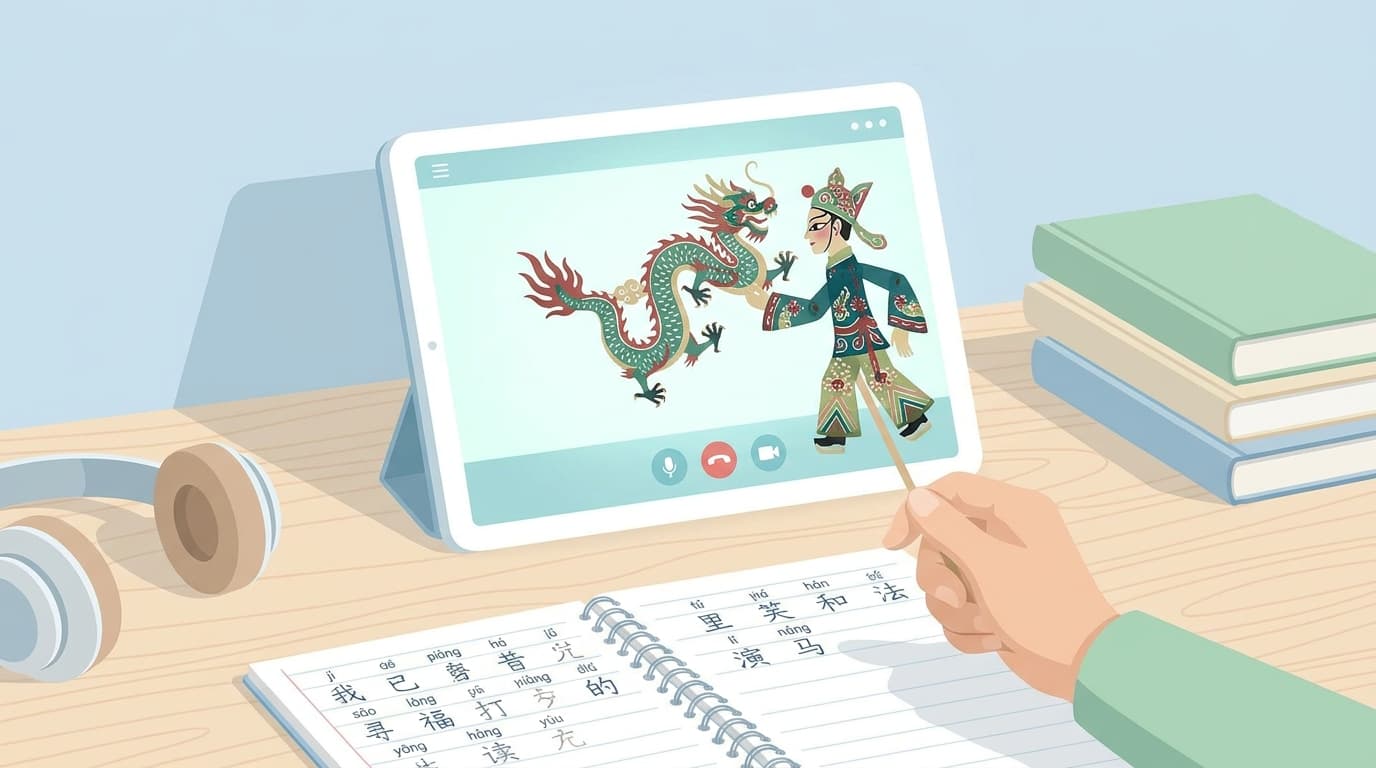
Chinese Shadowing Practice: Improve Fluency with Native Videos
Most learners can read Chinese far better than they can speak it, because they never train their mouth and ear together. Shadowing native videos fixes that gap, and this guide shows you exactly how to do it.
Shadowing means speaking along with a native speaker in real time, copying their rhythm, tones and pauses as closely as you can. It is one of the fastest ways to move from "I know the word" to "I can say it without thinking." A tool like Corodomo makes this practical for busy learners: paste a YouTube link or upload a video, and it auto-generates bilingual subtitles you can shadow line by line. You also get AI word lookup, pronunciation practice with CoroAI, and pinyin typing and dictation drills to lock in what your ears just heard. Instead of hunting for the perfect clip, you spend your 20 minutes actually speaking.
- What Chinese shadowing actually is (and what it isn't)
- Why native videos beat textbooks for fluency
- A step-by-step shadowing routine
- Tones, rhythm and the "Chinese mouth" problem
- Choosing the right videos and building a loop
- Tracking progress and avoiding plateaus
- FAQ
- Conclusion
What Chinese shadowing actually is (and what it isn't)
Shadowing is simultaneous imitation. You hear a native speaker say something and you say it at almost the same moment, like an echo that overlaps the original. You are not translating in your head and you are not waiting for the sentence to end. You are chasing the sound.
This is different from repetition, where you listen, pause, then repeat. Repetition trains memory. Shadowing trains timing, muscle memory and automaticity. When you shadow, your brain stops constructing sentences and starts copying them, which is exactly the skill you need in a real conversation.
It is also different from reading aloud. Reading aloud lets your eyes lead and your mouth follow your own habits. Shadowing forces your mouth to follow a native model, so bad habits get corrected instead of rehearsed.
One important note: shadowing is not a beginner's first step. You need a rough grasp of pinyin and tones first. If you cannot yet hear the difference between mā (妈, mother) and mà (骂, to scold), slow down and do more listening before you shadow.
- Shadow for 10–20 minutes, not an hour. Intensity matters more than duration.
- Start with slow, clear speech before you attempt fast native content.
- Do not pause the audio to think. Keep moving and let some words blur.
- Record yourself at least once a week to hear what you actually sound like.
- Never shadow text you have not listened to at least twice.
Example line to shadow:
我每天学习汉语。 – Wǒ měitiān xuéxí Hànyǔ. – "I study Chinese every day."
Why native videos beat textbooks for fluency
Textbook audio is clean, slow and emotionally flat. Real Chinese is fast, messy and full of contractions, filler words and tone changes. If you only train on textbook audio, your first real conversation will feel like a different language.
Native videos give you the full package: connected speech, gestures, facial expressions and context. When a speaker raises their eyebrows while saying 真的吗?(Zhēn de ma? – "Really?"), your brain stores the phrase with the emotion attached. That makes it far easier to recall later.
Videos also give you variety for free. A vlogger, a news anchor and a drama actor all speak differently. Shadowing across all three builds a flexible ear instead of a single-accent habit.
This is where Corodomo fits naturally. Because it generates bilingual subtitles from any video you paste or upload, you get the original Chinese line and its English meaning side by side. You can loop a single sentence, look up a word instantly, and then practice pronouncing it with CoroAI before moving on. The video stays the center of your study instead of becoming a distraction.
- Pick videos with clear audio and one or two speakers, not chaotic group scenes.
- Prefer content with natural pauses so you have breathing room.
- Use subtitles as a training wheel, then hide them.
- Reuse the same video across a week instead of hunting for new ones daily.
- Choose topics you actually enjoy, because you will hear them many times.
| Chinese | Pinyin | Meaning |
|---|---|---|
| 你好 | nǐ hǎo | hello |
| 谢谢 | xièxie | thank you |
| 对不起 | duìbuqǐ | sorry |
| 没问题 | méi wèntí | no problem |
A step-by-step shadowing routine
Here is a routine you can run in 20 minutes. It works for any level and any video, as long as the audio is clear.
Step 1 – Listen blind (3 minutes). Play the clip with no subtitles. Do not speak. Just notice the melody of the sentences. You are calibrating your ear.
Step 2 – Read along (3 minutes). Turn on bilingual subtitles. Read the Chinese line while listening, and glance at the English only when you are lost. Mark three or four words you do not know.
Step 3 – Chunk and drill (5 minutes). Break the clip into short chunks of 3–6 characters. Shadow each chunk five times slowly, then at normal speed. This is where Corodomo's word lookup and CoroAI pronunciation practice help, because you can check a tone before you drill it wrong fifty times.
Step 4 – Full shadowing (5 minutes). Now shadow the whole clip continuously. Do not stop for mistakes. If you fall behind, jump back in at the next sentence.
Step 5 – Lock it in (4 minutes). Turn off subtitles and shadow once more. Then do a quick dictation: type what you heard in pinyin or characters. Corodomo's pinyin typing and dictation drills are built for exactly this step.
- Set a timer so you do not over-polish one sentence.
- Drill chunks slowly before you drill them fast.
- Speak slightly louder than feels natural; it improves clarity.
- Finish every session with one full no-subtitle pass.
- Write down two phrases you want to reuse tomorrow.
Chunking example:
我今天 – wǒ jīntiān – "I today"
我今天很忙 – wǒ jīntiān hěn máng – "I'm very busy today."
Tones, rhythm and the "Chinese mouth" problem
Most learners' biggest block is not vocabulary. It is that their mouth has never produced these sounds before. English speakers flatten tones, swallow final consonants and rush syllables. Chinese needs the opposite: clear tone contours and even syllable weight.
Shadowing fixes this because you copy the pitch curve directly instead of reconstructing it from rules. If you shadow a native saying 妈 (mā, mother) with a high flat tone, your voice learns that shape. Rules tell you what to do; shadowing makes your body do it.
Pay special attention to third tone pairs. A single third tone is low and dipping, but two in a row change the first one. Shadowing makes this automatic. You will hear 你好 (nǐ hǎo) come out as "ní hǎo" and your mouth will simply follow.
Rhythm matters too. Chinese is syllable-timed, so each syllable gets roughly equal weight. Do not stress one syllable like in English. Keep the beat steady and let the tones carry the meaning.
- Exaggerate the tone contour at first, then dial it back to natural.
- Record yourself and compare tone by tone with the original.
- Practice tone pairs in isolation before full sentences.
- Slow the video to 0.75x, master it, then return to normal speed.
- Watch the speaker's mouth shape for rounded and unrounded vowels.
| Chinese | Pinyin | Meaning |
|---|---|---|
| 妈 | mā | mother (high flat tone) |
| 麻 | má | hemp (rising tone) |
| 马 | mǎ | horse (dipping tone) |
| 骂 | mà | to scold (falling tone) |
Choosing the right videos and building a loop
Your material choice decides half your progress. The best shadowing videos are 1–3 minutes long, have one clear speaker, and cover a topic with repeating vocabulary. Interviews, cooking demos, daily vlogs and short news segments all work well.
Avoid dense poetry, heavy dialect content and overlapping dialogue at the start. Those are great later, but they will crush a beginner's confidence.
Once you find a good clip, do not abandon it after one session. Build a loop: shadow the same clip on Monday, Wednesday and Friday. Each time, hide the subtitles earlier. By the third pass you will hear words you missed on day one, which is a very satisfying feeling.
If you want to expand, keep a running list of five clips at your level. Rotate them so you get variety without losing repetition. Corodomo's leveled vocabulary and flashcards let you pull the new words out of each video and review them separately, so the clip keeps paying off after you stop shadowing it.
- Keep a folder of 5 clips: two easy, two medium, one stretch.
- Reuse each clip at least three times before replacing it.
- Match video length to your free time, not to your ambition.
- Save new words as flashcards the same day you hear them.
- Revisit old clips monthly to hear your own improvement.
Everyday line worth stealing:
这个多少钱? – Zhège duōshao qián? – "How much is this?"
Tracking progress and avoiding plateaus
Shadowing progress is easy to feel but hard to measure. Two simple metrics keep you honest: how many seconds of video you can shadow without falling behind, and how many new words you can recall a week later.
Record a 60-second sample every two weeks. Do not judge it harshly. Just compare it to the previous one. Most learners hear a clear jump in rhythm and tone accuracy within a month, though the exact pace varies by person.
Plateaus usually come from one of three causes: material that is too hard, sessions that are too passive, or no review of new words. Fix all three by lowering difficulty, adding a no-subtitle pass, and running a short quiz on the week's vocabulary.
Corodomo's four vocabulary tests (choose the correct meaning, listen and type, type the reading, and write an example sentence) map neatly onto this. The listening and typing tests in particular reveal whether you truly heard the tones or just guessed them.
- Log seconds shadowed per session in a simple note.
- Re-test last week's words before learning new ones.
- Change material if you have plateaued for two weeks.
- Add one speaking session per week with no script at all.
- Celebrate small wins; fluency is built from boring repetitions.
| Chinese | Pinyin | Meaning |
|---|---|---|
| 我明白了 | wǒ míngbai le | I understand now |
| 再说一遍 | zài shuō yí biàn | say it again |
| 慢慢来 | mànman lái | take your time |
FAQ
How long should I shadow each day?
Ten to twenty focused minutes is plenty for most learners. Quality beats quantity here. If you can only manage ten minutes, do ten minutes every day rather than an hour once a week.
Should I use subtitles while shadowing?
Yes, but only in the middle of the session. Start blind to train your ear, use bilingual subtitles to check meaning, then finish without subtitles. Relying on text the whole time turns shadowing into reading practice.
Can beginners shadow Chinese?
Beginners can start once they know pinyin and can hear basic tones. Use very short, slow clips and drill chunks of three to five characters. If tones still sound identical to you, spend two weeks on listening first.
Is shadowing better than repeating after the speaker?
They train different things. Repeating builds memory and accuracy. Shadowing builds timing, rhythm and automatic recall. Use both: repeat to learn a line, then shadow to make it fluent.
What if I cannot keep up with fast native speech?
Slow the video to 0.75x and shadow that. Once it feels comfortable, return to normal speed. Falling behind is normal at first; just rejoin at the next sentence instead of restarting.
Conclusion
Chinese shadowing practice with native videos works because it trains your ear and mouth at the same time, on real speech, in real time. Three things matter most. First, keep sessions short and intense, around ten to twenty minutes. Second, use a clear routine: listen blind, read along, chunk and drill, shadow fully, then lock it in with dictation. Third, reuse the same clips and review the words you pull from them.
Do this consistently for a month and you will notice smoother tones, better rhythm and faster recall in conversation. Pair your shadowing with tools that keep the video at the center of your study, and the whole process becomes far less frustrating.
Try Corodomo: Learn languages · Learn via Video · Exam practice