

Languages


AI for Language Learning: Get Instant Speaking Feedback

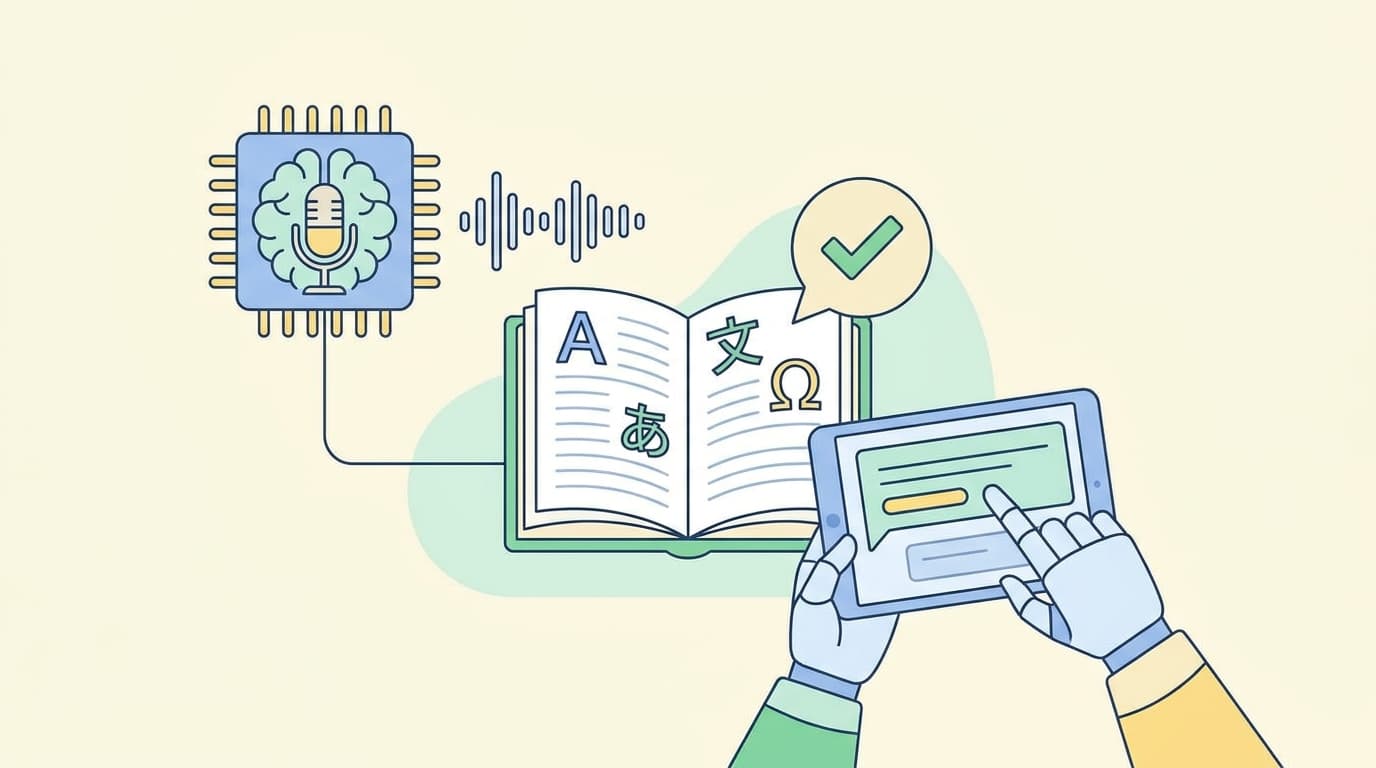
Self-study often leaves learners stuck in a loop of uncertainty about their pronunciation and fluency.
Breaking this cycle requires immediate, accurate correction that traditional textbooks cannot provide. Corodomo addresses this by turning real videos into interactive lessons with AI speaking feedback. You shadow sentences from the video, get a pronunciation score for every word, and refine your accent without scheduling a tutor. This approach allows busy learners to integrate high-quality speaking drills into their daily routine efficiently.
- Why Instant Feedback Matters for Speaking
- How AI Analyzes Your Speech Accuracy
- Practical Steps to Practice with AI Tools
- Overcoming Common Speaking Challenges with AI
- Integrating AI into Your Daily Routine
- Frequently Asked Questions
Why Instant Feedback Matters for Speaking
Language acquisition relies heavily on the feedback loop. When you speak, your brain needs to know immediately if the output was correct. Traditional classroom settings often delay this feedback. A teacher might correct you after a full sentence or even after a complete presentation. This delay makes it harder to connect the error with the specific muscle movement or tonal shift required.
Instant feedback closes this gap. It allows you to adjust your tongue position, breath control, or pitch in real time. This immediacy accelerates neural pathway formation. You stop reinforcing bad habits before they become ingrained. For self-learners, this is critical because there is no instructor present to catch subtle mistakes during solo practice sessions.
Moreover, immediate correction boosts confidence. Many learners hesitate to speak due to fear of judgment. An AI tool provides a safe, private space to make mistakes. You can repeat a phrase fifty times without feeling embarrassed. This psychological safety encourages experimentation with complex sentences and new vocabulary. It transforms speaking from a performance into a mechanical skill that can be drilled and perfected.
Consider the difference between guessing and knowing. Without feedback, you might assume your pronunciation is adequate. You may continue using an incorrect tone in Chinese or a wrong vowel length in Japanese. Over time, these small errors compound, making you difficult to understand. AI tools highlight these discrepancies instantly, ensuring you build a solid foundation from day one.
- Record yourself speaking a target sentence.
- Listen to the AI’s assessment of your accuracy.
- Identify specific phonemes or tones that were marked incorrect.
- Repeat the sentence, focusing only on the corrected element.
- Record again to verify improvement.
Example: Japanese Pitch Accent
箸 hashi (はし) – High-Low pattern – Meaning: Chopsticks
橋 hashi (はし) – Low-High pattern – Meaning: Bridge
AI feedback that checks pitch accent helps you hear and fix these subtle differences.
How AI Analyzes Your Speech Accuracy
Modern AI speech recognition goes beyond simple word matching. It analyzes acoustic features such as pitch, duration, and intensity. For tonal languages like Mandarin Chinese, the system evaluates the contour of your voice against standard tonal models. It checks if your first tone is high and level, or if your fourth tone falls sharply. This granular analysis is impossible to achieve with basic audio recording apps.
The technology uses large datasets of native speaker recordings. These datasets train the AI to recognize variations in accent and speed. When you speak, the AI compares your input to these native benchmarks. It calculates a similarity score for each syllable or word. This score provides an objective measure of your progress. It removes the subjectivity often found in peer reviews or self-assessment.
Furthermore, AI tools can detect rhythm and stress patterns. In English and German, stress timing is crucial for intelligibility. Misplaced stress can change the meaning of a word or make a sentence sound unnatural. Some AI tools flag these rhythmic errors on the specific word, so you know exactly where you rushed or dragged a syllable.
Corodomo integrates this technology directly into its video-based learning environment. You do not practice isolated words. You shadow full sentences taken from real videos in Japanese, English, Chinese, Korean, German or Thai, and the AI scores your pronunciation down to each word. For Japanese, the feedback also covers pitch accent. Because the sentences come from real speech, your practice reflects real-world communication, including the way words connect in natural speaking.
- Understand that AI evaluates pitch, duration, and intensity.
- Recognize that tonal languages require contour analysis.
- Use word-level feedback to locate stress and rhythm errors.
- Trust objective similarity scores over subjective feelings.
- Practice full sentences, not just single words, for natural connected speech.
| Language Feature | AI Analysis Focus | Benefit to Learner |
|---|---|---|
| Mandarin Tones | Pitch contour mapping | Prevents meaning confusion |
| Japanese Pitch | High/Low pattern detection | Improves natural flow |
| English Stress | Syllable duration/intensity | Enhances intelligibility |
Practical Steps to Practice with AI Tools
To get the most out of AI feedback, you need a structured approach. Randomly speaking into a microphone yields limited results. Start by selecting a short, manageable segment of content. This could be a single sentence from a video or a common phrase. Ensure you understand the meaning and grammar before attempting to speak it. Comprehension precedes production.
Next, listen to the native audio multiple times. Pay attention to the nuances. Notice how the speaker connects words. Observe their emotional tone and speed. Try to mimic this internally before producing sound. This mental rehearsal primes your articulatory muscles. It creates a clearer target for the AI to evaluate against.
Now, record your attempt. Speak clearly but naturally. Do not exaggerate your pronunciation unless you are specifically drilling a difficult sound. Submit your recording to the AI tool. Review the feedback carefully. Do not just look at the overall score. Dive into the details. Which specific word was flagged? Was it a vowel issue or a tonal error?
Iterate based on the feedback. If the AI marks a specific syllable as incorrect, isolate that sound. Practice it in isolation. Then, reintegrate it into the word. Finally, place the word back into the sentence. This chunking method prevents overwhelm. It allows you to fix errors systematically.
- Select a short, comprehensible sentence or phrase.
- Listen to native audio repeatedly for modeling.
- Record your speech clearly and naturally.
- Analyze specific feedback points, not just the score.
- Isolate and correct errors before re-recording.
Example: Chinese Pinyin
Māma (妈妈) – High level first tone, then a light neutral tone – Meaning: Mother
Mǎ (马) – Dipping Tone – Meaning: Horse
AI detects if the dip in "Mǎ" is deep enough.
Overcoming Common Speaking Challenges with AI
One major challenge for learners is the plateau effect. You may feel like you are not improving despite consistent practice. AI helps break through this plateau by providing micro-goals. Instead of aiming for "fluency," you aim for a 90% accuracy score on a specific sentence. This gamification keeps motivation high. It provides tangible evidence of progress, even when overall fluency feels stagnant.
Another challenge is anxiety. Speaking a new language can be stressful. Many learners freeze up in conversation. AI offers a low-stakes environment. There is no human judge. You can make mistakes without social consequence. This freedom lets you practice the same sentence until it feels natural, so you arrive at real conversations with phrases you have already said many times.
A third challenge is not knowing what to practice. Learners often open a speaking app and say random words. A better approach is to take sentences from content you have just understood, such as a video you watched. Because you already know the meaning, all your attention can go to pronunciation and rhythm.
Finally, some learners chase a perfect score. AI scores are a guide, not a final verdict. Background noise, microphone quality and natural variation all affect the result. If you consistently score well on a sentence and a native speaker understands you easily, move on.
- Set small targets, such as one clean sentence per session.
- Practice in a quiet place with a decent microphone.
- Choose sentences you understand completely before speaking.
- Compare your score over days, not single attempts.
- Move on once a sentence is consistently clear.
Integrating AI into Your Daily Routine
AI feedback works best as a short daily habit. Ten to fifteen minutes is enough when the practice is focused. The key is to combine listening, understanding and speaking in one flow instead of treating them as separate tasks.
Here is a simple routine. Watch a short video and understand it with the help of subtitles. Pick three sentences you would like to be able to say. Listen to each one several times, then shadow it and read the feedback. Fix the weakest word, repeat the sentence, and save any new words as flashcards. The next day, start by shadowing yesterday's sentences once more before moving on.
If you want more guidance, structured programs can help. On Corodomo, Plus and Pro members can use AI Coaching, a guided one-on-one shadowing program. Free users can still shadow sentences in the video library within the AI usage allowance.
| Minutes | Activity | Goal |
|---|---|---|
| 0–3 | Shadow yesterday's sentences | Review and check progress |
| 3–8 | Watch a new short clip with subtitles | Understand meaning |
| 8–13 | Shadow three sentences with AI feedback | Fix specific words |
| 13–15 | Save new words as flashcards | Retain vocabulary |
Frequently Asked Questions
Can AI replace a human teacher for speaking practice?
Not completely. AI is excellent for instant, patient pronunciation feedback and lets you practice as often as you like. A human teacher or conversation partner is still valuable for spontaneous conversation and cultural nuance.
How accurate is AI pronunciation feedback?
Modern speech assessment is reliable at spotting clearly wrong sounds and words. Treat the score as a guide, practice in a quiet place, and focus on the words it flags rather than small changes in the overall score.
Is AI feedback useful for beginners?
Yes. Beginners benefit the most, because early feedback prevents bad habits such as wrong tones in Chinese or flat pitch in Japanese from becoming permanent.
How often should I practice speaking with AI?
Daily short sessions work better than occasional long ones. Ten to fifteen minutes a day with a few well-chosen sentences is a strong routine.
Conclusion
AI has made instant speaking feedback available to every self-learner. Remember three points. First, practice with short sentences you fully understand. Second, use the detailed feedback to fix specific words instead of chasing a perfect score. Third, make it a daily habit by combining video input, shadowing and review.
Try it yourself with shadowing and AI pronunciation feedback on Corodomo, or browse the video library to find your first sentences.