

Languages


BrSE Japanese: Communication Skills for Bridge Engineers

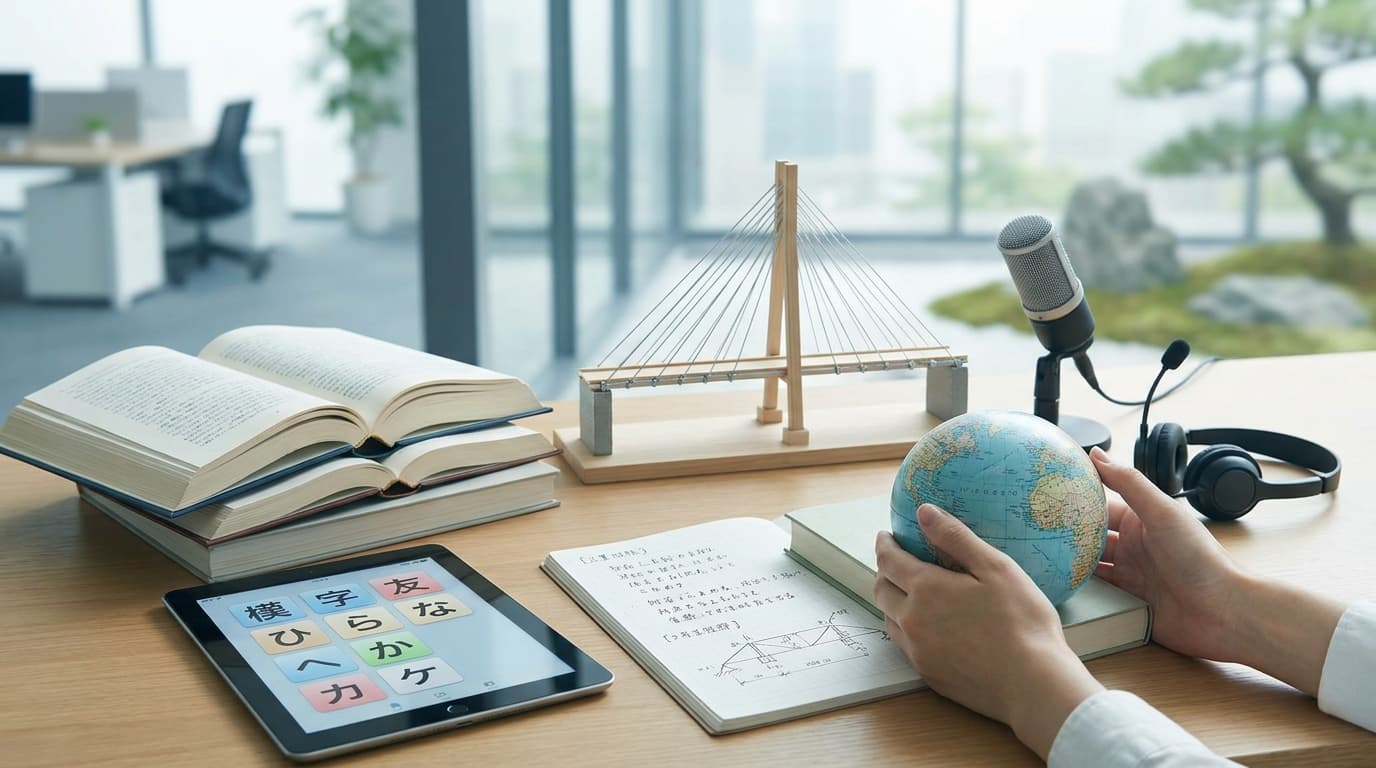
BrSE Japanese: Communication Skills and Vocabulary for Bridge System Engineers
BrSE work lives or dies on communication, yet most engineers learn technical Japanese in isolation from real meetings. This guide gives you the vocabulary, phrases and habits to bridge the gap.
The BrSE (Bridge System Engineer) role sits between a Japanese client and a development team, so you translate not only words but intent, risk and expectation. The fastest way to build that skill is to work with real recorded conversations: on Corodomo you can paste a YouTube link or upload a meeting recording, and it auto-generates bilingual subtitles you can study line by line. AI word lookup, CoroAI speaking practice and vocabulary tests then turn those phrases into active knowledge, so you walk into the next 定例 (teirei, regular meeting) actually prepared.
- What a BrSE actually does all day
- Core BrSE vocabulary you will hear weekly
- Meeting phrases: confirming, clarifying, pushing back
- Email and chat writing conventions
- Soft skills: 報連相 and expectation management
- A weekly self-study routine that fits a busy job
What a BrSE actually does all day
A BrSE is the human interface between a Japanese customer and an offshore or nearshore engineering team. You join requirements meetings, translate specifications, chase decisions, and explain delays without losing trust. Your Japanese does not need to be poetic, but it must be precise under pressure.
That means your priority is not JLPT grammar breadth. It is a compact set of recurring situations: clarifying a requirement, confirming a deadline, reporting a bug, and asking for a decision. Each situation has predictable vocabulary and sentence patterns you can rehearse in advance.
Most BrSEs describe the same pain point: they understand the words in a meeting but miss the nuance. Is 検討します (kentō shimasu, "we'll consider it") a yes, a no, or a polite stall? Reading between the lines is a language skill, and it improves fastest with repeated exposure to real spoken Japanese.
- List the five meeting types you attend most, and prepare a phrase sheet for each.
- Record one real meeting per week (with permission) and review the subtitles afterwards.
- Keep a running glossary of client-specific terms, not just general IT vocabulary.
- After each meeting, write a three-line Japanese summary and send it for confirmation.
| Japanese | Reading | Meaning |
|---|---|---|
| 要件定義 | yōken teigi | requirements definition |
| 進捗 | shinchoku | progress |
| 課題 | kadai | issue / open problem |
| 納期 | nōki | delivery deadline |
Core BrSE vocabulary you will hear weekly
BrSE vocabulary splits into three layers: general business Japanese, IT-specific terms, and project-specific jargon. Learn them in that order. General business words appear in every email, IT terms appear in specs, and project jargon you pick up on the job.
Start with the highest-frequency nouns and verbs, then attach them to sentence patterns. For example, 確認 (kakunin, confirmation) combines with する to make 確認します (I will confirm), 確認をお願いします (please confirm), and 確認済みです (already confirmed). One noun, three useful tools.
Words like 勉強 (benkyō, study) and 仕事 (shigoto, work) are worth learning deeply because they appear constantly in small talk and self-introductions. You can see full breakdowns on the 勉強 word page and the 仕事 word page, including example sentences you can reuse in client conversations.
- Learn nouns together with their する verb form, not alone.
- Group vocabulary by meeting type so you can rehearse whole scenarios.
- Use a dictionary lookup for every unknown word in a real email you receive.
- Review new terms within 24 hours, then again after a week.
| Japanese | Reading | Meaning |
|---|---|---|
| 仕様書 | shiyōsho | specification document |
| 見積もり | mitsumori | estimate / quotation |
| 不具合 | fuguai | defect / bug |
| 修正 | shūsei | fix / correction |
| 対応 | taiō | handling / response |
| 共有 | kyōyū | sharing (information) |
Meeting phrases: confirming, clarifying, pushing back
Meetings are where BrSE Japanese matters most. You need phrases that confirm understanding without sounding confrontational, and phrases that slow the conversation down when you are lost. Politeness is not decoration here; it is how you keep the room calm.
The single most useful pattern is 〜という理解でよろしいでしょうか (…to iu rikai de yoroshii deshō ka, "is my understanding that… correct?"). It lets you restate a requirement and get a clean yes or no. Use it at the end of every requirements discussion.
For pushback, avoid blunt refusals. Instead of できません (dekません, "we can't"), say 現状のスケジュールでは難しいですが、代替案を提案します (genshō no sukejūru de wa muzukashii desu ga, daitai-an o teian shimasu, "it's difficult with the current schedule, but we propose an alternative"). You stay honest and cooperative at once.
すみません、もう一度おっしゃっていただけますか。
Sumimasen, mō ichido osshatte itadakemasu ka.
"Sorry, could you say that once more?"
- Rehearse three clarifying phrases aloud until they are automatic.
- Confirm every deadline by repeating the date and time back.
- Never say yes to a scope change in the meeting; say you will confirm internally.
- Practise pronunciation with CoroAI so key phrases sound calm, not rushed.
| Japanese | Reading | Meaning |
|---|---|---|
| 確認させてください | kakunin sasete kudasai | let me confirm |
| 認識が合っていますか | ninshiki ga atte imasu ka | are we aligned on this? |
| 〜の件ですが | 〜 no ken desu ga | regarding the matter of… |
| 結論から申し上げますと | ketsuron kara mōshiagemasu to | to start with the conclusion |
Email and chat writing conventions
Japanese business writing follows a predictable shape: greeting, context, request, closing. Learning that shape saves you more time than memorising hundreds of kanji. Once the skeleton is in place, you only swap the content.
A standard email opens with お世話になっております (osewa ni natte orimasu, "thank you for your continued support"). It then states the topic with 〜の件 (〜 no ken, "regarding…"), gives the body, and closes with よろしくお願いいたします (yoroshiku onegai itashimasu, "thank you in advance").
Kanji accuracy matters because a wrong character signals carelessness. Characters like 勉 (diligence, as in 勉強) and 学 (learning, as in 学ぶ) appear in training and documentation contexts. The 勉 kanji page and the 学 kanji page break down readings and compounds, which helps you write correctly the first time.
- Build three email templates: status report, delay notice, and decision request.
- Keep sentences short; long Japanese sentences invite ambiguity.
- Use bullet points for lists of issues, as Japanese clients often do.
- Proofread with a dictionary lookup for every kanji you typed from memory.
ご連絡ありがとうございます。進捗について共有いたします。
Go-renraku arigatō gozaimasu. Shinchoku ni tsuite kyōyū itashimasu.
"Thank you for your message. I'd like to share the progress."
Soft skills: 報連相 and expectation management
報連相 (hōrensō) stands for 報告 (hōkoku, report), 連絡 (renraku, contact) and 相談 (sōdan, consultation). It is the backbone of Japanese workplace communication, and BrSEs are judged on how well they practise it. Silence is read as hiding problems, not as competence.
Report early, even when the news is bad. A short message saying a bug was found and a fix is being investigated builds more trust than waiting for a complete answer. Japanese clients expect incremental updates, not dramatic reveals.
Expectation management is the other half. When you translate a client request for your team, separate the must-have from the nice-to-have explicitly. Then tell the client what will be delivered and when, in writing, and confirm they agree.
- Send a brief status update even when there is nothing new to report.
- Flag risks as soon as you notice them, with a proposed next step.
- Write down every verbal decision and confirm it in a follow-up message.
- Ask 相談があります (sōdan ga arimasu, "I have something to consult you about") when you need guidance.
| Japanese | Reading | Meaning |
|---|---|---|
| 報告 | hōkoku | report |
| 連絡 | renraku | contact / notify |
| 相談 | sōdan | consultation |
| 確認 | kakunin | confirmation |
A weekly self-study routine that fits a busy job
You do not need three hours a day. You need a routine that recycles real work material, because BrSE Japanese is a narrow, deep skill. Fifteen focused minutes on phrases you will use tomorrow beats an hour of generic textbook study.
A practical loop: pick one short video or meeting clip, watch it with bilingual subtitles, extract five phrases, then test yourself on them later in the week. On Corodomo you can generate bilingual subtitles from a YouTube link, look up each word in detail, and then drill the phrases with flashcards and level-based vocabulary lists.
The four vocabulary test modes are especially useful for BrSE prep: choose the correct meaning, listen and type, type the reading, and write an example sentence. The last one forces you to produce client-ready Japanese rather than merely recognise it.
- Monday: choose one real meeting clip and generate subtitles.
- Tuesday: extract five phrases and add them to flashcards.
- Wednesday: practise pronunciation of those phrases with CoroAI.
- Thursday: take a vocabulary test, including the example-sentence mode.
- Friday: use at least three phrases in real emails or meetings.
来週の定例までに、この課題を共有します。
Raishū no teirei made ni, kono kadai o kyōyū shimasu.
"I'll share this issue before next week's regular meeting."
For vocabulary depth, the Japanese dictionary is a quick way to check readings, pitch and example sentences before you commit a word to your flashcards.
FAQ
What Japanese level do I need to become a BrSE?
Most job listings ask for around JLPT N2 as a rough benchmark (this is an estimate based on common postings, not an official rule). In practice, precise business phrases and listening confidence matter more than test scores. Many BrSEs pass N2 and still struggle in fast meetings, so practise real conversation early.
Is BrSE Japanese different from normal business Japanese?
It overlaps heavily but adds IT vocabulary and project jargon. You also need strong clarification and reporting skills, because miscommunication can cost real money. Focus on meeting phrases, email templates and 報連相 habits.
How do I ask a Japanese client to repeat something politely?
Use すみません、もう一度お願いできますか (sumimasen, mō ichido onegai dekimasu ka, "sorry, could you say that once more?"). For a specific point, say 〜について、もう少し詳しく教えていただけますか (could you explain a little more about…).
How can I practise BrSE Japanese if I have no Japanese colleagues?
Use recorded material. Generate bilingual subtitles for real business videos, shadow the speakers, and test yourself on extracted phrases. Corodomo's AI Q&A and video summaries also help you check whether you actually understood the content.
Should I learn kanji handwriting as a BrSE?
Recognition matters more than handwriting, since most work is typed. Still, writing common characters helps you remember them and avoid typos. Prioritise the characters that appear in your own documents and emails.
Conclusion
Three points to take away. First, BrSE Japanese is a narrow skill: master the recurring meeting, email and reporting situations before chasing broad grammar. Second, precision beats fluency, so rehearse confirmation phrases such as 〜という理解でよろしいでしょうか until they are automatic. Third, build a weekly loop around real recordings, turning each meeting into flashcards, pronunciation practice and vocabulary tests.
Do that consistently and your Japanese stops being a barrier and starts being the thing that makes you the trusted bridge between two teams.
Try Corodomo in English: Learn languages · Learn via Video · Exam practice