
Ngôn ngữ
Video Context vs Flashcards: Boost Language Retention

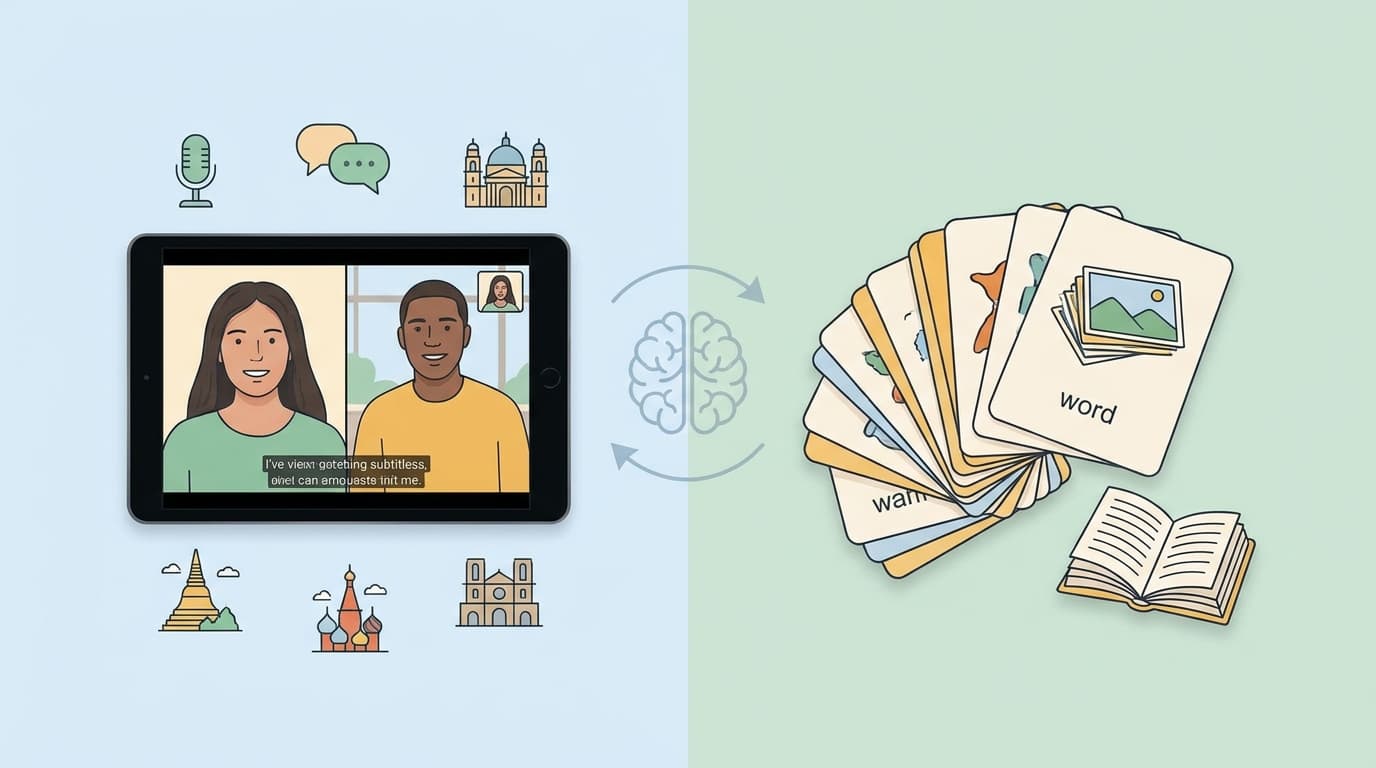
Comparing Language Apps: Why Video Context Beats Flashcards for Retention
Most learners quit because they memorize words but cannot understand real conversations. Video-based learning solves this by anchoring vocabulary in meaningful, memorable situations.
Traditional study methods often fail because they strip language of its soul. You might know the definition of a word, but you do not know how it feels in a sentence. This is where Corodomo changes the game. It allows you to learn directly through bilingual videos by auto-generating subtitles from any YouTube link. Instead of staring at static cards, you engage with real native speech, using AI tools to lookup words and practice pronunciation instantly. This approach bridges the gap between textbook knowledge and real-world comprehension.
- The Isolation Trap of Traditional Flashcards
- The Power of Video Context for Memory
- Active Engagement vs. Passive Recognition
- How to Implement Video-Based Learning
- Comparing Tools: Static Apps vs. Video Platforms
- Frequently Asked Questions
The Isolation Trap of Traditional Flashcards
Flashcards are the most common tool in language learning. They are convenient and portable. However, they suffer from a critical flaw: decontextualization. When you see a word on a card, you lack the situational cues that define its usage. Your brain stores the translation, not the concept.
This leads to the "recognition trap." You recognize the word when you see it in isolation. Yet, you fail to recall it during a fast-paced conversation. The neural pathway for retrieval is weak because it was never tested in a dynamic environment. You know the map, but you cannot drive the car.
Consider the Japanese word 勉強 (benkyou). On a flashcard, it means "study." But in real life, it is often used humbly. If someone compliments you, you might say "I still need to study" to show humility. A flashcard rarely teaches this nuance. For deeper insights, you can explore the meaning of 勉強 in various contexts.
Without context, learners also struggle with collocations. These are words that naturally go together. Knowing "make" and "decision" separately is easy. Knowing that we "make" a decision rather than "do" a decision requires exposure. Flashcards rarely provide enough examples to internalize these patterns effectively.
- Avoid single-word cards: Always include a full sentence on your flashcards.
- Add audio clips: Ensure you hear the word pronounced by a native speaker.
- Include images: Visual cues help bypass translation and link directly to meaning.
- Limit daily new cards: Focus on quality over quantity to prevent burnout.
Example of Context Failure:
Word: 切手 (kitte)
Flashcard Meaning: Stamp
Real Context: Used specifically for postage stamps, not rubber stamps. Without video context, learners often misuse this in office settings.
The Power of Video Context for Memory
Video provides rich, multi-sensory input. You see the speaker’s facial expressions. You hear the intonation and emotion. You observe the physical setting. These cues create multiple hooks for memory retention. This is known as dual-coding theory in cognitive science.
When you watch a scene in a drama, the emotional stakes help anchor the vocabulary. If a character shouts a word in anger, you remember the intensity. This emotional connection makes the memory stickier than a black-and-white text definition. Your brain prioritizes information tied to survival or social interaction.
Take the Chinese word 麻烦 (máfan). It can mean "trouble" or "inconvenient." In a video, you might see a character struggling with a broken taxi. The visual frustration clarifies the meaning instantly. You understand it is not just a noun, but a feeling of annoyance. This depth is impossible to get from a static list.
Video also exposes you to natural speech speed and reductions. Native speakers blend sounds. They drop particles. Textbooks often present sanitized, slow audio. Video prepares you for the reality of fluent speech. It trains your ear to parse continuous sound streams into distinct words.
- Watch short clips: Focus on 1-2 minute segments for intensive study.
- Turn off subtitles first: Test your listening before relying on text support.
- Shadow the dialogue: Repeat lines immediately after hearing them to mimic rhythm.
- Note body language: Observe how gestures reinforce the spoken message.
| Language | Word/Phrase | Contextual Meaning |
|---|---|---|
| Korean | 대박 (daebak) | Jackpot/Huge success. Often used in variety shows when something surprising happens. |
| German | Feierabend | The end of the workday. Culturally significant time for relaxing, not just "evening." |
| Japanese | よろしく (yoroshiku) | Nice to meet you/Please treat me well. Depends entirely on tone and bowing depth. |
Active Engagement vs. Passive Recognition
Watching TV passively is not enough. You must engage actively with the content. This is where many learners fail. They binge-watch shows but retain little. Active engagement requires you to pause, look up words, and test your understanding. It turns entertainment into education.
Platforms like Corodomo facilitate this active process. You can paste a YouTube link and get bilingual subtitles instantly. If you miss a word, you can click it for a detailed AI lookup. This immediate feedback loop prevents confusion from building up. It keeps you in the flow state of learning.
For Japanese learners, understanding kanji in motion is vital. Seeing 仕事 (shigoto) written while a character talks about their job reinforces the link. You can check the definition of 仕事 to see how it differs from other work-related terms. The visual component of the kanji becomes associated with the professional context.
Speaking practice is another form of active engagement. Many apps ignore output. Corodomo includes CoroAI for pronunciation practice. You speak into the microphone, and the AI gives feedback. This closes the loop between input and output. You are not just consuming; you are producing.
- Pause and predict: Before the subtitle appears, guess what was said.
- Summarize aloud: After a clip, summarize the main point in the target language.
- Use dictation tools: Type what you hear to improve listening accuracy.
- Ask AI questions: Use integrated AI to ask why a certain grammar point was used.
Active Learning Task:
Select a 30-second video clip.
1. Listen without subtitles.
2. Listen with target language subtitles.
3. Look up unknown words.
4. Listen again with bilingual subtitles.
5. Shadow the dialogue three times.
How to Implement Video-Based Learning
Integrating video into your routine does not require hours of free time. It requires strategy. Start by curating content that matches your level. If you are a beginner, use children’s shows or learner-focused channels. Advanced learners can tackle news or dramas. The key is comprehensible input.
Use technology to reduce friction. Manually typing subtitles is tedious. Auto-generation tools save time. Corodomo supports Japanese, Chinese, Korean, English