
Ngôn ngữ
Learn Korean with K-Drama Scripts: Dictation Method

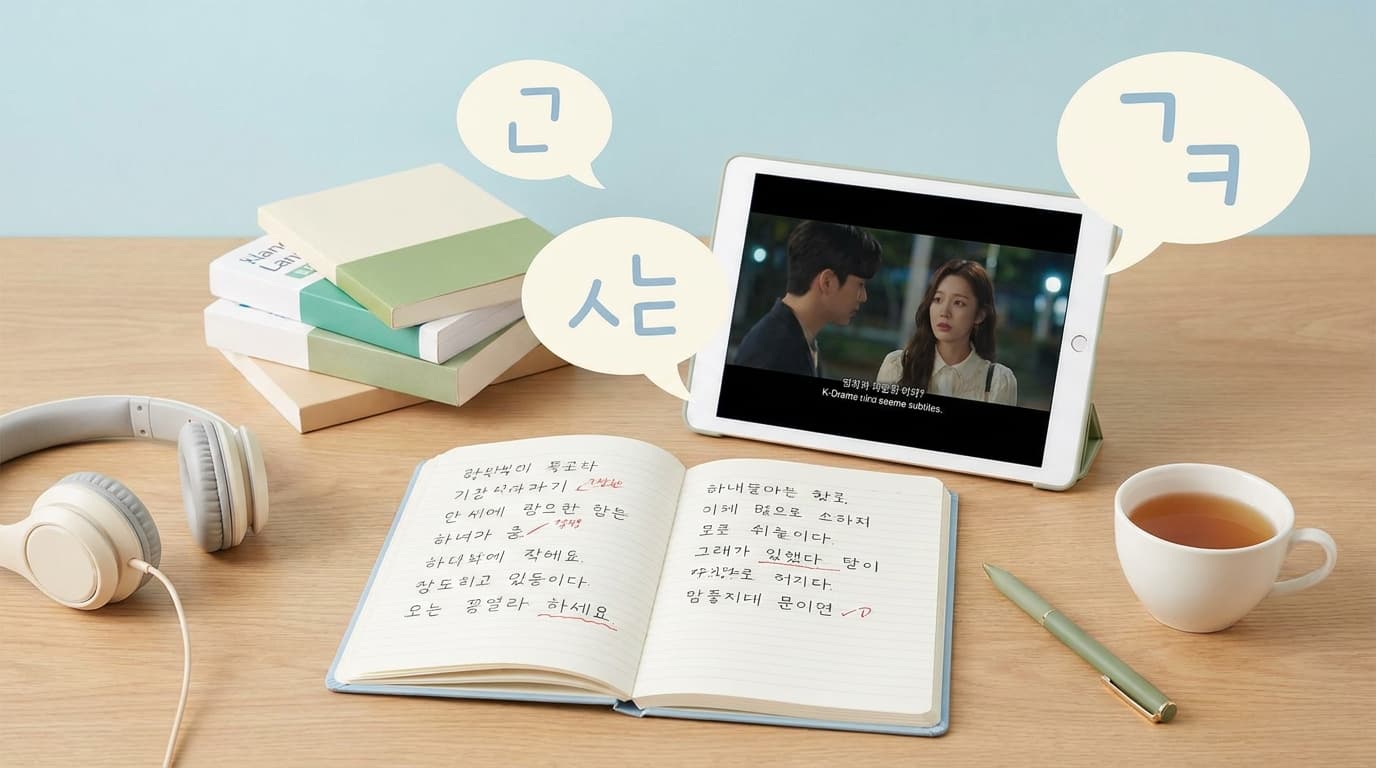
Learn Korean Online with K-Drama Scripts: A Dictation Method for Intermediate Learners
You have mastered Hangul and basic grammar, but native Korean dialogue still sounds like a blur. Dictating K-drama scripts bridges the gap between classroom Korean and real spoken Korean, training your ear and your pen at the same time.
If you are an intermediate learner, you already know that textbook dialogues do not sound like real conversations. K-drama scripts are full of natural expressions, emotional intonation, and everyday vocabulary that you simply cannot find in a grammar workbook. The dictation method forces you to listen actively, catch every syllable, and write what you hear — which is exactly how Korean children learn to spell. With a tool like Corodomo, you can paste a YouTube link to any K-drama clip and generate bilingual subtitles instantly. This gives you a clean script to check your dictation against, plus AI word lookup for the vocabulary you miss. You can also practice shadowing with pronunciation feedback, making the entire process active rather than passive.
- Why Dictation Works for Intermediate Korean Learners
- How to Choose the Right K-Drama Scene
- Step-by-Step Dictation Practice
- Common Pitfalls and How to Overcome Them
- Turning Dictation into Vocabulary and Grammar Mastery
- How to Track Your Progress Over 30 Days
- Frequently Asked Questions
- Conclusion
Why Dictation Works for Intermediate Korean Learners
Dictation is not just a schoolroom exercise. For intermediate Korean learners, it is a high-intensity listening workout that targets multiple skills at once. When you write down a Korean sentence you hear, you activate phonological awareness, orthographic memory, and syntactic parsing simultaneously. This is far more effective than passively watching with subtitles.
Research in second-language acquisition suggests that dictation improves bottom-up listening skills — the ability to decode individual sounds and words. Korean has many sound-change rules (연음, 구개음화, 비음화) that make spoken Korean different from written Korean. Dictation forces you to confront these rules head-on. For example, the phrase 잘 먹겠습니다 is often pronounced like 잘 머겟씀니다 in fast speech. If you only read the script, you will never train your ear to catch these changes.
Another benefit is spelling. Korean spelling is largely phonetic, but there are tricky areas like double consonants (ㄲ, ㄸ, ㅃ, ㅆ, ㅉ) and tense vs. lax consonants. Dictation makes you pay attention to these distinctions because you have to choose the correct spelling for every word you write. Over time, your spelling accuracy improves without rote memorization.
- Active listening: Dictation forces you to focus on every sound, not just the gist.
- Spelling mastery: You learn to distinguish similar sounds through writing practice.
- Grammar in context: You internalize verb endings and particles naturally.
- Intonation awareness: You pick up emotional cues from the actor's delivery.
Example dictation practice
Audio: "오늘 진짜 힘들었어." (spoken casually)
Your writing: 오늘 진짜 힘들었어.
Reading: oneul jinjja himdeureosseo
Meaning: "Today was really tough."
How to Choose the Right K-Drama Scene
Not every K-drama scene is suitable for dictation. As an intermediate learner, you need scenes that challenge you without overwhelming you. A good rule of thumb is the 80/20 rule: you should understand about 80 percent of the vocabulary and grammar, leaving 20 percent as new material to learn. This keeps the frustration low and the learning high.
Start with daily-life dramas rather than historical or legal ones. Shows like Reply 1988, Hospital Playlist, or Because This Is My First Life feature realistic conversations between friends, family, and colleagues. The vocabulary is practical and the speech speed is moderate. Avoid action or fantasy dramas where characters shout or use unnatural dialogue — these are not good models for everyday Korean.
The ideal scene length for dictation is 30 to 60 seconds. Any longer and you will struggle to remember the whole sentence. Choose a scene with two or three speakers so you get exposure to different speech styles: banmal (반말, informal) between friends and jondaemal (존댓말, polite) with elders or strangers. This variety is essential for intermediate learners.
- Length: 30–60 seconds of dialogue, about 3–5 sentences.
- Speed: Natural but not rushed. Avoid scenes with yelling or overlapping dialogue.
- Vocabulary: Mostly words you have seen before, with a few new ones.
- Speech styles: A mix of informal and polite forms for well-rounded practice.
| Drama Title | Recommended Episode | Scene Description | Difficulty |
|---|---|---|---|
| Reply 1988 | Episode 1 | Family dinner conversation | Intermediate |
| Hospital Playlist | Episode 3 | Friends chatting at a café | Upper-intermediate |
| Because This Is My First Life | Episode 2 | Contract marriage discussion | Intermediate |
| Crash Landing on You | Episode 4 | Simple daily interactions | Lower-intermediate |
Step-by-Step Dictation Practice
Now that you have your scene, it is time to practice. This step-by-step method is designed for self-learners with limited time. You can complete one dictation session in 15 to 20 minutes, making it easy to fit into a busy schedule. Consistency matters more than session length.
Step 1: Listen without writing. Play the scene once with your eyes closed. Focus on the rhythm, intonation, and emotional tone. Do not try to catch every word. Just get a feel for the conversation. This primes your brain for the detailed listening to come.
Step 2: Listen and write in chunks. Play the scene again, pausing after each sentence or clause. Write down what you hear. Do not rewind yet — just write what you caught. Leave blanks for words you missed. This is your raw dictation. It will have gaps and errors, and that is fine.
Step 3: Rewind and fill gaps. Go back to the parts you missed. Play them two or three times at slower speed if possible. Fill in as many blanks as you can. At this stage, you can also look up the Korean dictionary on Corodomo to check unfamiliar words you think you heard.
Step 4: Check against the script. Compare your dictation with the official or bilingual subtitles. This is where the real learning happens. Mark every difference: a wrong particle, a missed consonant, a misheard word. Analyze why you made each error. Was it a sound-change rule? A vocabulary gap? Fast speech?
Step 5: Shadow and repeat. Read the corrected script aloud while listening to the original. Mimic the actor's intonation and speed. Do this three times. Then try to speak the lines without looking at the script. This moves the language from your eyes to your mouth.
- Use a notebook dedicated to dictation — one scene per page.
- Write the date and drama title at the top of each entry.
- Highlight new vocabulary in a different color.
- Review your past dictations once a week to see progress.
Sample dictation practice
Audio line: "이거 진짜 맛있어. 누가 만들었어?"
Your raw dictation: 이거 진자 맛있서. 누가 만드렸어?
Corrected script: 이거 진짜 맛있어. 누가 만들었어?
Reading: igeo jinjja masisseo. nuga mandeureosseo?
Meaning: "This is really delicious. Who made it?"
Analysis: You misheard 짜 as 자, and the past tense ending -었어 as -었서.
Common Pitfalls and How to Overcome Them
Every intermediate learner hits a plateau. Dictation can feel frustrating when you keep missing the same types of sounds. Let us address the most common problems and give you practical solutions so you can keep progressing.
Problem 1: Sound-change rules. Korean has complex phonological rules. For example, ㄴ often changes to ㄹ in certain environments, and final consonants can change pronunciation depending on the following syllable. The word 한국말 (hangukmal) is pronounced 한궁말 (hangungmal) due to nasalization. If you do not know these rules, dictation becomes guesswork. Solution: study the seven major sound-change rules with audio examples. Practice each rule separately with minimal pairs.
Problem 2: Particle confusion. Korean particles like 이/가, 은/는, and 을/를 are often reduced or blended in fast speech. You might hear 친구가 as 친구가 with a very light 가, or even 친구아 in some dialects. Solution: focus on the context. If the particle is marking the subject, it is likely 이/가. If it is marking the topic, it is 은/는. Over time, your ear will distinguish them better.
Problem 3: Homophones and similar sounds. Korean has many sounds that are difficult for English speakers, especially ㄱ/ㅋ/ㄲ, ㄷ/ㅌ/ㄸ, and ㅂ/ㅍ/ㅃ. The difference between 살 (flesh) and 쌀 (rice) is crucial. Solution: practice minimal pairs with a native speaker or with a pronunciation tool like Corodomo's speaking practice, which gives you real-time feedback on your articulation.
- Rule 1: Always write the exact characters you hear, even if they seem wrong.
- Rule 2: After checking the script, say the corrected version out loud ten times.
- Rule 3: Keep a list of your most frequent errors and review them daily.
- Rule 4: Practice with the same scene multiple days in a row until you can dictate it perfectly without pausing.
Example of a common error
Audio: "밥 먹었어요?" (bap meogeosseoyo?)
Misheard as: "밥 머거써요?" (bap meogeosseoyo?)
Correct: 밥 먹었어요?
Reading: bap meogeosseoyo?
Meaning: "Did you eat?"
Issue: The learner missed the ㄱ in 먹었어요 due to the ㄱ being softened between vowels. Practice listening for the subtle ㄱ in 먹다 and similar verbs.
Turning Dictation into Vocabulary and Grammar Mastery
Dictation is not just about listening — it is a gateway to deeper vocabulary and grammar acquisition. Every scene you dictate contains rich language data. The key is to extract that data and turn it into active knowledge. Do not just correct your dictation and move on. Spend an extra ten minutes mining the scene for new words, phrases, and grammar patterns.
Start by identifying all the verbs and their conjugations. Korean verbs change form based on tense, politeness level, and mood. In a 30-second scene, you might encounter past tense, present tense, and future intention all in one exchange. Write each verb in its base form (dictionary form) and note the conjugation used. For example, if you hear 갈게요 (galgeyo), note that the base form is 가다 (gada) and the ending -ㄹ게요 expresses a promise or intention.
Next, look at particles and connectors. Korean uses particles like 에, 에서, 로, and 부터 to show relationships between words. Dictation exposes you to these in natural contexts. When you write 학교에 가요 (school-to go), you see the particle 에 attached to a place noun. This is far more memorable than memorizing a grammar chart.
Finally, collect phrases rather than single words. Korean is highly formulaic, and many expressions are fixed chunks. Phrases like 어떻게 지내세요? (how are you?), 잘 부탁드립니다 (please take care of me), and 그런 거 아니에요 (that is not it) appear in multiple dramas. By dictating them, you internalize them as complete units, which makes your speaking more fluent.
- After each dictation, create a vocabulary list of 5–10 new words.
- Write each word in Hangul, with the reading and meaning.
- Use the Corodomo Korean dictionary to check example sentences for each word.
- Review your lists using spaced repetition or flashcards.
Vocabulary extraction example
Sentence from a drama: "내일 꼭 전화할게."
Word breakdown:
내일 (naeil) – tomorrow
꼭 (kkok) – surely
전화할게 (jeonhwahalge) – I will call (promise form)
Base verb: 전화하다 (jeonhwahada) – to call
Grammar focus: -ㄹ게 expresses a promise or intention.
How to Track Your Progress Over 30 Days
One of the biggest challenges for self-learners is measuring progress. Dictation gives you a concrete metric: your error rate. By tracking how many errors you make per scene, you can see improvement over time. Start by dictating one scene every day for 30 days. Each scene should be from a different episode or drama to expose you to varied vocabulary and speech styles.
On day one, you might make fifteen errors in a 30-second scene. By day thirty, that number could drop to three or four. That is measurable progress. Keep a log where you record the date, the drama, the number of errors, and the types of errors (sound-change, spelling, particle, vocabulary). Review your log weekly to spot patterns. If you keep missing the same sound-change rule, that is your signal to study it specifically.
Another way to track progress is speed. Time how long it takes you to complete a dictation session — from first listen to final correction. As your ear improves, you will need fewer rewinds and less time to fill gaps. A session that took twenty minutes on day one might take twelve minutes by day thirty. This efficiency gain is a strong indicator of improved listening processing.
- Week 1: Focus on 30-second scenes. Expect 10–15 errors per scene.
- Week 2: Move to 45-second scenes. Errors should drop to 8–10.
- Week 3: Try 60-second scenes. Errors around 5–8.
- Week 4: Return to 30-second scenes. Aim for fewer than 5 errors.
Progress tracking example
Day 1: Scene from Reply 1988, 30 seconds, 14 errors.
Day 7: Same episode, different scene, 30 seconds, 9 errors.
Day 14: Scene from Hospital Playlist, 45 seconds, 10 errors.
Day 21: Scene from Because This Is My First Life, 60 seconds, 7 errors.
Day 28: New scene from Reply 1988, 30 seconds, 4 errors.
You can clearly see improvement in speed, length, and accuracy.
Frequently Asked Questions
How long should I practice dictation each day?
For intermediate learners, 15 to 20 minutes of focused dictation per day is ideal. This is short enough to fit into a busy schedule but long enough to make meaningful progress. Consistency is more important than duration. If you can only do 10 minutes some days, that is still beneficial.
What if I cannot find Korean subtitles for the scene I want to dictate?
You can use a tool like Corodomo to generate bilingual subtitles for any YouTube video or uploaded file. This gives you both Korean and English subtitles to check your dictation against. Alternatively, many K-dramas on streaming platforms have Korean subtitles available — just select Korean from the subtitle menu.
Should I use formal or informal speech for dictation practice?
You should practice both. Intermediate learners need exposure to all speech levels. A good strategy is to choose scenes with mixed speech — for example, a conversation between friends (informal) and a boss (formal) in the same episode. This prepares you for real-life situations where you switch between speech styles.
Is dictation effective for TOPIK preparation?
Yes, dictation is excellent for TOPIK preparation because it trains your listening comprehension and spelling, both of which are tested in TOPIK I and II. The dictation method also reinforces grammar and vocabulary, which are crucial for the reading and writing sections. Many TOPIK high-scorers incorporate dictation into their study routine.
What if I have been studying for years but still struggle with listening?
This is a common problem called the "listening plateau." Dictation is one of the most effective ways to break through it because it forces active, detailed listening rather than passive understanding. Start with slower scenes and gradually increase speed. Also, consider using the pronunciation and speaking practice features on Corodomo to get feedback on your own articulation, which helps you recognize sounds more accurately.
Conclusion
Learning Korean online through K-drama script dictation is a powerful, practical method for intermediate learners. By combining active listening, writing, and correction, you train multiple skills simultaneously and develop a natural feel for the language. Three key takeaways from this article: first, dictation improves your listening accuracy by forcing you to catch every sound, especially tricky sound-change rules. Second, mining dictation scripts for vocabulary and grammar patterns turns passive exposure into active knowledge you can use in your own speech. Third, tracking your error rate over time gives you clear, measurable proof of progress — something every self-learner needs to stay motivated.
Start today. Pick a 30-second scene from your favorite K-drama, grab a notebook, and listen with fresh ears. With consistent practice and the right tools, you will find that the once-blurry stream of Korean dialogue becomes clearer, word by word, sentence by sentence.
Try Corodomo: Learn languages · Learn via Video · Exam practice