
Ngôn ngữ
Learn Japanese Online: Zero to JLPT N1 Roadmap

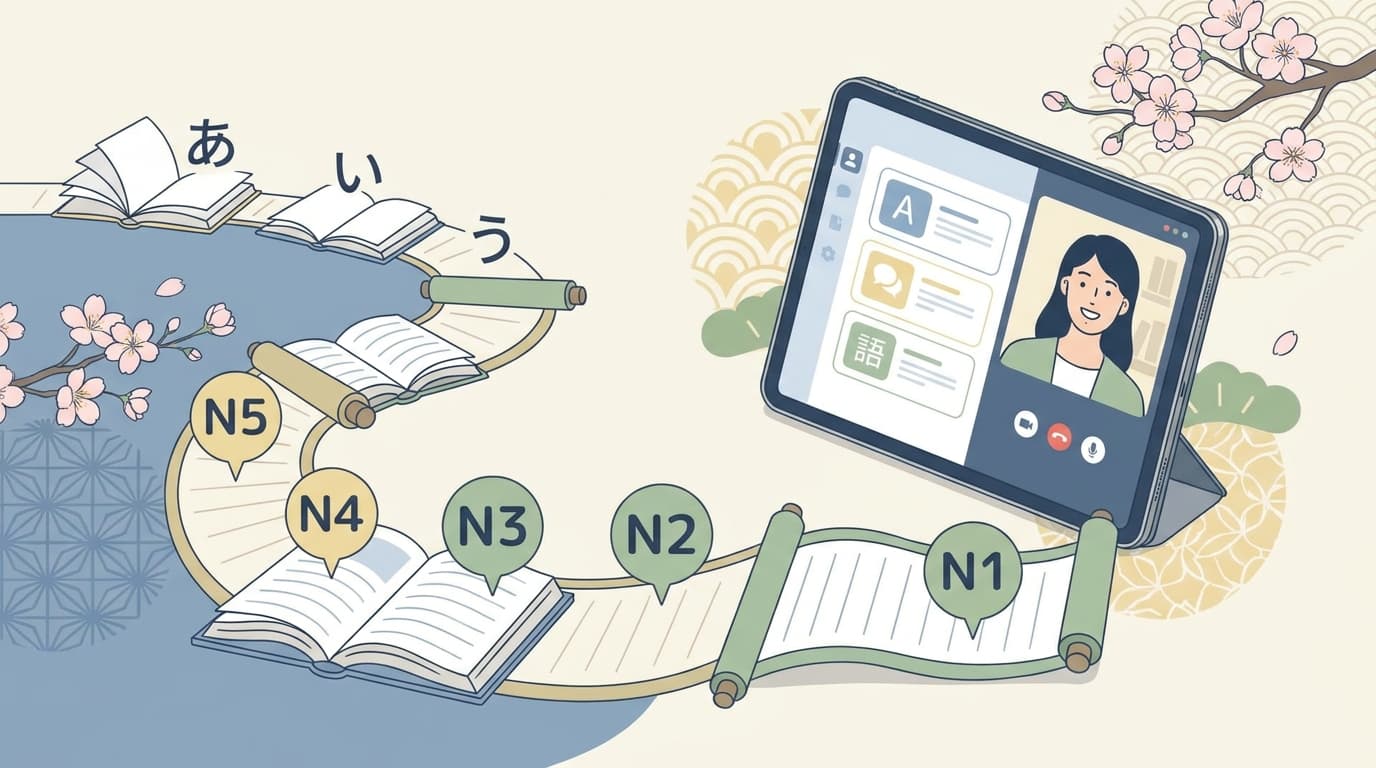
How to Learn Japanese Online: A Complete Roadmap from Zero to JLPT N1
Many learners quit Japanese because traditional textbooks feel disconnected from real conversation. This guide offers a practical, video-first strategy to build lasting fluency.
Self-study often fails due to a lack of context and immediate feedback. Corodomo solves this by letting you learn directly from bilingual videos. You can paste any YouTube link to generate auto-synced subtitles. The platform also provides AI-driven pronunciation practice and detailed word lookups. This approach keeps you engaged with content you actually enjoy while building core skills.
- Step 1: Mastering the Writing Systems
- Step 2: Building a Grammar Framework
- Step 3: Conquering Kanji Efficiently
- Step 4: Deep Immersion with Video
- Step 5: Advanced Output and N1 Prep
- Frequently Asked Questions
- Conclusion
Step 1: Mastering the Writing Systems
Japanese uses three distinct writing systems. You must learn them in a specific order to avoid confusion. Start with Hiragana. It is the phonetic backbone of the language. Every Japanese sound has a Hiragana character. Do not rely on Romaji (Latin alphabet). Romaji creates bad pronunciation habits early on.
Next, learn Katakana. This script is used for foreign loanwords. Since English speakers use many loanwords in Japanese, Katakana is highly useful. It looks different from Hiragana but represents the same sounds. Practice reading both scripts until they become automatic. This usually takes two weeks of consistent study.
Finally, understand the role of Kanji. These are Chinese characters adopted into Japanese. They carry meaning rather than just sound. Do not try to memorize all Kanji at once. Instead, learn them alongside vocabulary. Context helps your brain retain complex characters. Use spaced repetition systems to review them regularly.
- Write each character by hand to build muscle memory.
- Use mnemonics to remember tricky shapes.
- Read simple children’s books to practice recognition.
- Avoid using Romaji after the first week.
Example:
hiragana: あ (a) – vowel sound
katakana: ア (a) – vowel sound
kanji: 日 (nichi/hi) – sun/day
Step 2: Building a Grammar Framework
Japanese grammar is very different from English. The verb always comes at the end of the sentence. Particles mark the function of each word. For example, "wa" marks the topic. "Wo" marks the direct object. Understanding these particles is crucial for basic comprehension.
Start with polite form (Desu/Masu). This is safe for most social situations. Once comfortable, explore plain form. Plain form is used with friends and family. It is also essential for understanding casual speech in movies. Do not rush into complex conjugations. Master the present and past tense first.
Textbooks often teach grammar in isolation. This makes it hard to apply rules in real life. Video-based learning bridges this gap. When you watch a video on Corodomo, you see grammar in action. You hear how natives connect sentences naturally. This contextual learning sticks better than rote memorization.
- Focus on one particle per week.
- Create simple sentences using new grammar points.
- Listen to native dialogues to hear rhythm.
- Shadow speakers to improve intonation.
| Japanese | Reading | Meaning |
|---|---|---|
| 私は寿司を食べます。 | Watashi wa sushi o tabemasu. | I eat sushi. |
| 彼は学校に行きました。 | Kare wa gakkou ni ikimashita. | He went to school. |
Step 3: Conquering Kanji Efficiently
Kanji is often the biggest hurdle for learners. There are over 2,000 joyo (common use) Kanji. Trying to memorize them by stroke order alone is inefficient. Instead, learn radicals. Radicals are the building blocks of characters. Knowing them helps you guess meanings and readings.
Context is king when learning Kanji. A single character can have multiple readings. Onyomi comes from Chinese origins. Kunyomi is the native Japanese reading. Which one you use depends on the word. For instance, the character for "study" appears in many compounds. See 勉強 (benkyou) for a common example.
Use technology to speed up this process. Tools like Japanese Dictionary help you break down words. When you encounter a new Kanji, look up its components. Understand why it looks the way it does. This logical approach reduces frustration. It turns abstract shapes into meaningful stories.
- Learn Kanji in vocabulary pairs, not isolation.
- Study radicals to decode complex characters.
- Review Kanji daily using spaced repetition.
- Write Kanji to reinforce visual memory.
Kanji Breakdown:
Character: 勉 + 学
Word: 勉強 (Benkyou)
Meaning: Study / Effort
Step 4: Deep Immersion with Video
Immersion is the key to fluency. You need thousands of hours of input. But passive listening is not enough. You must engage with the content actively. Traditional methods make this hard. You often pause to look up words in a separate app. This breaks your flow and kills motivation.
Video platforms change this dynamic. With Corodomo, you can upload any video. The system generates bilingual subtitles automatically. You can click on any word for an instant definition. This keeps you in the "flow state." You learn from content you love, whether it is news, vlogs, or anime.
Active watching involves more than just reading subs. Listen for words you know. Try to predict the next phrase. Use the AI features to check your understanding. If a sentence is confusing, ask the AI Q&A feature. It explains grammar nuances within the video context. This turns entertainment into a powerful lesson.
- Choose videos slightly above your current level.
- Watch short clips repeatedly for mastery.
- Use bilingual subs to bridge gaps.
- Summarize the video in simple Japanese.
| Activity | Tool Feature | Benefit |
|---|---|---|
| Listening | Auto-subtitles | Connects sound to text |
| Vocabulary | AI Lookup | Instant context-aware definitions |
| Speaking | CoroAI | Real-time pronunciation feedback |
Step 5: Advanced Output and N1 Prep
Reaching JLPT N1 requires advanced output skills. You must speak and write with precision. Many learners stall at the intermediate plateau. They understand much but cannot express complex ideas. To break through, you must produce language daily. Writing journals and speaking to AI partners helps.
Pronunciation matters more at advanced levels. Native speakers notice subtle accent errors. Use