
Ngôn ngữ
Korean Grammar for Real Conversation: Beginner Patterns

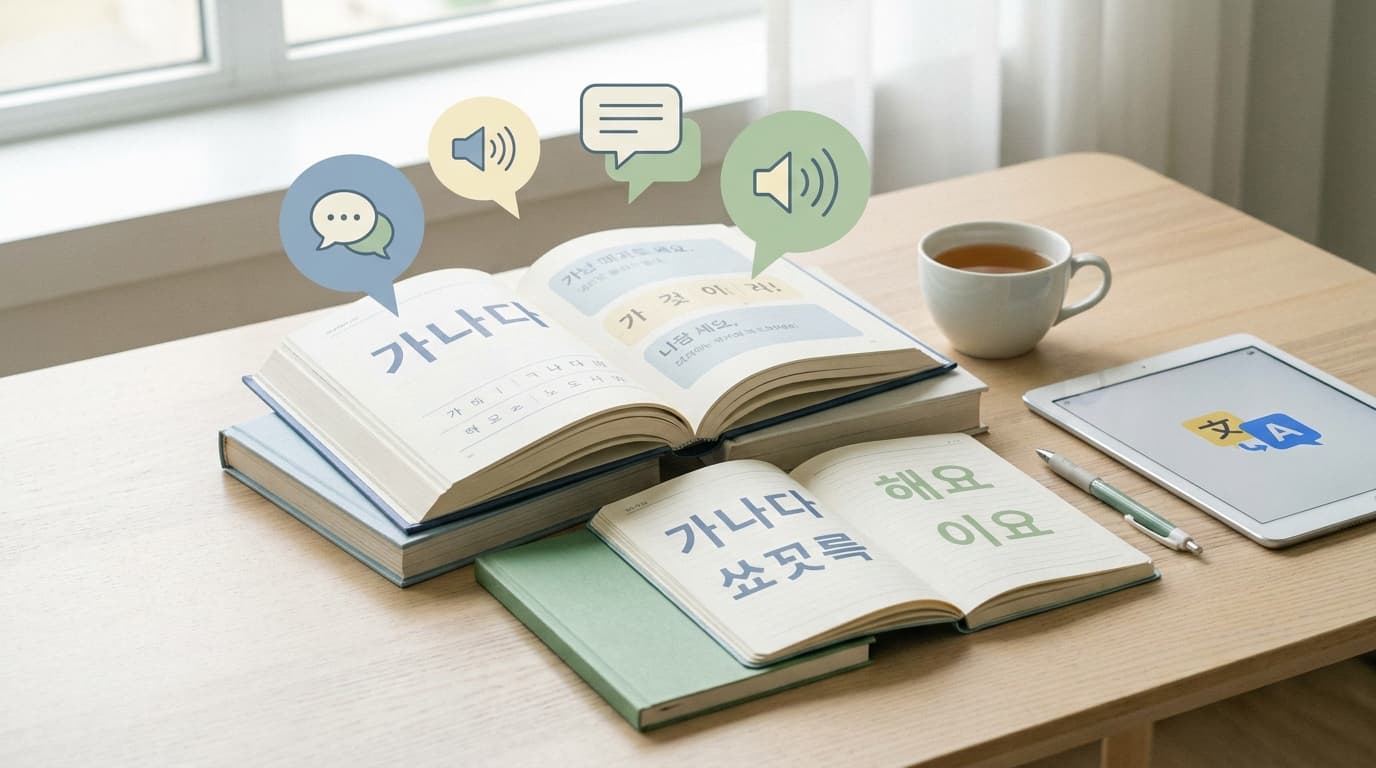
Korean Grammar in Real Conversation: The Most Useful Beginner Patterns Beyond Textbooks
Struggling to connect your textbook lessons to the way native speakers actually talk? Bridging the gap between rigid grammar rules and authentic, fast-paced Korean conversation is the biggest hurdle for intermediate-bound learners.
To overcome this, Corodomo offers a modern solution that transforms your favorite YouTube videos into immersive language classrooms. By letting you paste any URL to generate instant bilingual subtitles and providing AI-powered word lookup, Corodomo allows you to see these grammar patterns in their natural habitat. Whether you are practicing your listening with dictation or using our Corodomo speaking tools to perfect your pronunciation, you can move away from memorizing lists and toward genuine understanding through context.
- The Polite Ending Gap: -아요 vs -읍시다
- Causality in Speech: -어서/아서 vs -니까
- Intent and Planning: -(으)려고 하다 vs -기로 하다
- Progressive Actions: -고 있다 vs -는 중이다
- Reporting Speech: -다고 하다 in Daily Life
- Frequently Asked Questions
The Polite Ending Gap: -아요 vs -읍시다
Textbooks often teach -아요/-어요 (polite style) and -읍시다 (let's) as separate, static rules. In reality, native speakers shift these endings based on the subtle power dynamics of a conversation. Using -읍시다 can sometimes sound overly formal or even authoritative, which might not be what you intend when talking to a friend or a slightly senior colleague.
Instead, many Koreans prefer using the -아요/-어요 ending with a rising intonation to suggest an action. It sounds softer and less demanding. This is a common pattern you will notice quickly when using Corodomo to analyze clips from Korean dramas or variety shows, where characters negotiate plans without being overly stiff.
- Observe the context: Is the speaker suggesting or demanding?
- Practice "softening" your requests using polite endings.
- Use Corodomo to listen to how native speakers stress these endings.
| Expression | Reading | Meaning |
|---|---|---|
| 같이 가요 | Gachi gayo | Let's go together (polite/casual) |
| 같이 갑시다 | Gachi gapsida | Let's go together (formal/authoritative) |
Causality in Speech: -어서/아서 vs -니까
Learners often confuse -어서/-아서 (because/and) with -니까 (since/because). In textbooks, these are often taught as simple synonyms. In real conversation, the distinction is about the flow of information. -어서 is used when the cause is internal or logical, while -니까 is used to give a reason that justifies a command or a suggestion.
When you are watching a video on Corodomo, pay attention to the sentences where a speaker is trying to persuade someone. You will hear -니까 used much more frequently than -어서 because it carries that "active" push behind the reason. It is the grammar of justification.
- Use -어서 for simple explanations or chronological events.
- Use -니까 when making requests or providing a justification for a follow-up action.
- Listen for these in YouTube content to hear the shift in emphasis.
비가 와서 집에 있어요. (Biga waseo jibe isseoyo.) - Because it is raining, I am staying home (simple fact).
비가 오니까 우산 챙겨요! (Biga onikka usan chaeng-yeoyo!) - Since it's raining, take an umbrella (justification for a request).
Intent and Planning: -(으)려고 하다 vs -기로 하다
Have you ever struggled to explain your plans? Beginners often mix up "planning to do" (intent) and "deciding to do" (agreement). -(으)려고 하다 refers to your internal desire or plan, while -기로 하다 represents a decision, often made after some deliberation or agreement with others.
In spoken Korean, these markers are often shortened. -려고 is frequently clipped to -럴 때, or simply inferred through context. Using Corodomo’s interactive subtitles helps you pause and analyze these contractions, which are almost never taught in traditional classes but are essential for sounding natural.
- Identify whether the plan is a personal goal or a firm arrangement.
- Practice saying both forms to get comfortable with the sound.
- Check your comprehension with Corodomo’s AI word lookup.
| Expression | Reading | Meaning |
|---|---|---|
| 운동하려고 해요 | Undong-haryeogo haeyo | I am planning to exercise (intent) |
| 운동하기로 했어요 | Undong-hagiro haesseoyo | I have decided to exercise (agreement/decision) |
Progressive Actions: -고 있다 vs -는 중이다
-고 있다 is the standard way to say "I am doing [x]." However, native speakers often switch to -는 중이다 when they want to emphasize that they are "in the middle of" something and shouldn't be disturbed. It is a subtle difference that makes you sound much more like a fluent speaker.
If you are busy and someone calls, saying "I am eating" can sound vague. "I am in the middle of eating" (-는 중이에요) creates a clearer boundary. Use Corodomo’s speaking exercises to practice this, focusing on the rhythm of the phrase to ensure it sounds natural rather than robotic.
- Use -고 있다 for general ongoing states.
- Use -는 중이다 to highlight that you are currently busy with a task.
- Listen for this in casual vlogs on YouTube to see when it's used.
공부하고 있어요. (Gongbu-hago isseoyo.) - I am studying (general).
공부하는 중이에요. (Gongbu-haneun jung-ieyo.) - I am in the middle of studying (don't interrupt).
Reporting Speech: -다고 하다 in Daily Life
The "indirect quotation" form (-다고 하다) is famously difficult for learners. It feels like a lot of extra work to say, "He said that he is going." However, in conversation, Koreans use shortened versions like -대요 (for -다고 해요) all the time. If you don't learn these contractions, you will struggle to follow casual gossip or news-sharing.
Learning these through native audio is crucial. Corodomo allows you to bridge this gap by letting you listen to the same clip multiple times. You can use the AI-generated flashcards to drill these colloquial reporting endings until they become second nature.
- Learn the contracted forms: -대요, -래요, -재요.
- Practice listening to fast speech to identify these markers.
- Use Corodomo's quiz feature to master the transformations.
| Full Form | Contracted Form | Meaning |
|---|---|---|
| 간다고 해요 | 간대요 | They say they are going |
| 먹는다고 해요 | 먹는대요 | They say they are eating |
Frequently Asked Questions
Why is it so hard to understand native Korean speakers?
Native speakers use contractions and shortcuts that textbooks often omit. Using video-based tools like Corodomo helps you get used to these natural speech patterns through authentic listening practice.
Is memorizing grammar rules enough to speak well?
No. You need to see grammar in action. Reading lists of rules is less effective than seeing how those rules are applied in real sentences, which is why we recommend active video immersion.
How can I improve my Korean listening speed?
Dictation is the best method. Use Corodomo to listen to short clips, type what you hear, and compare it with the subtitle to train your brain to parse fast speech.
Are there specific tools to help with Korean vocabulary?
Yes, Corodomo provides leveled vocabulary lists and flashcards based on the videos you watch, ensuring you learn words that are actually useful and relevant to your interests.
Conclusion
Improving your Korean requires three key steps: moving beyond the textbook to observe real speech, using context to understand nuance, and practicing consistently with native audio. By focusing on how Koreans actually structure their sentences—using soft endings, justifying actions, and contracting quotes—you will sound significantly more natural. Don't just study the language; immerse yourself in it through Corodomo to bridge the gap between learner and fluent speaker effectively.
[Try Corodomo, in English]: [Learn languages, in English] · [Learn via Video, in English] · [Exam practice, in English]