
Ngôn ngữ
Korean for Business: Essential Workplace Phrases

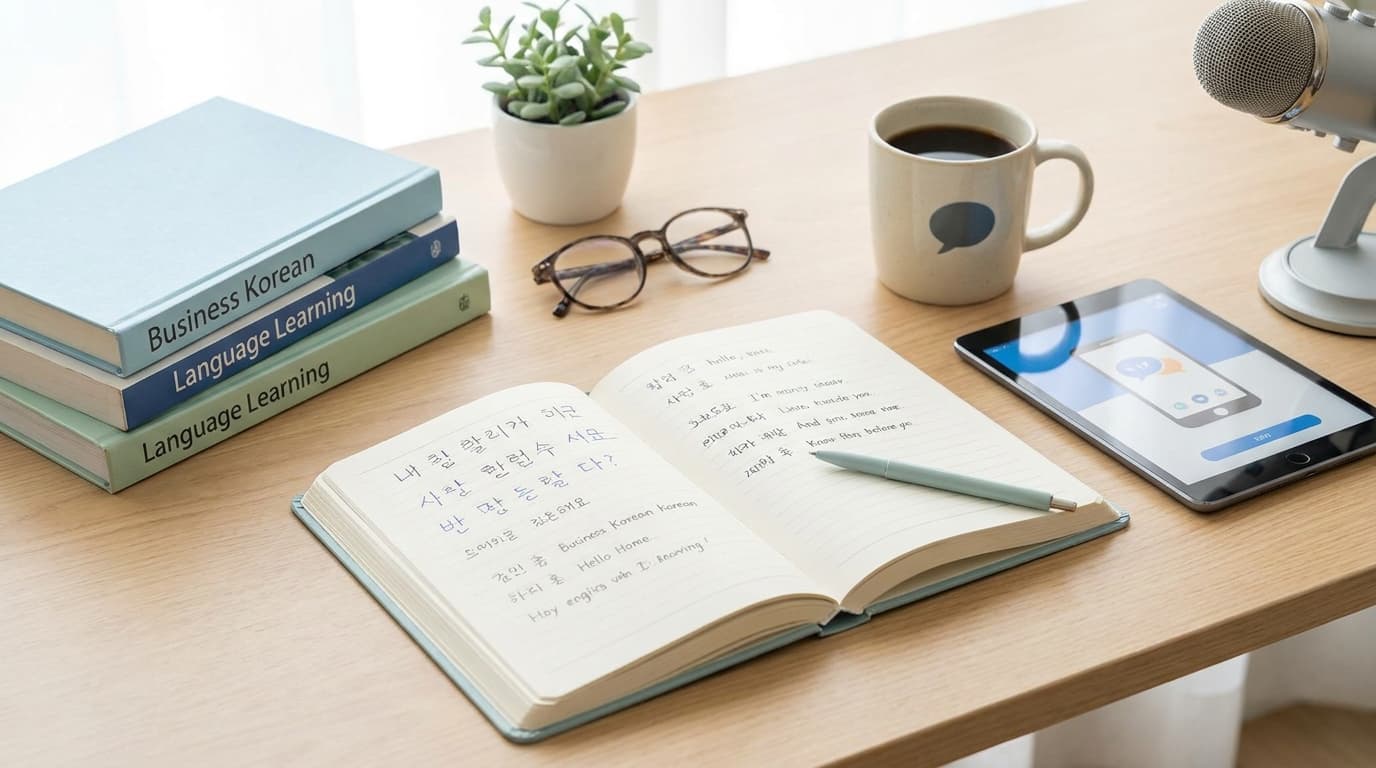
Korean for Business: Essential Phrases and Etiquette for the Workplace
Korean workplace language is not just polite Korean — it is a different register with its own titles, verbs and unwritten rules. This guide gives you the phrases and etiquette you can use in your next meeting, email or office day.
Most learners hit the same wall: textbook Korean gets you through a café order, then collapses the moment a manager asks you a question in a meeting. Business Korean solves that with a small, high-frequency toolkit — honorific verb endings, job titles instead of names, and set phrases for greetings, apologies and requests. Tools like Corodomo help here because you can paste a real Korean business YouTube clip or company video and get bilingual subtitles, then look up each word with an AI dictionary, drill the vocabulary in flashcards, and practise the pronunciation with CoroAI until the honorific endings stop feeling foreign. That loop — watch, look up, repeat aloud — is exactly how workplace phrases stick.
- Why Business Korean Feels Different
- Greetings and First Contact Phrases
- Titles, Names and How to Address People
- Meeting and Email Phrases That Work
- Etiquette Rules: Bowing, Cards, Drinking, Seating
- How to Practise Business Korean in 15 Minutes a Day
- FAQ
- Conclusion
Why Business Korean Feels Different
Korean has speech levels, and the workplace sits firmly in the formal-polite zone. The verb stem you learned as 가다 (gada – to go) becomes 갑니다 (gamnida) in a report and 가십니다 (gasimnida) when the subject is your boss. Same meaning, three different social signals.
On top of that, Korean business culture leans on nunchi (눈치) — reading the room. A junior employee often does not say "I disagree." They say something softer, and the senior person reads the hesitation. If you only translate English sentences word for word, you will sound blunt even when your grammar is perfect.
The good news: you do not need thousands of words. A core of roughly 200 business expressions covers most daily office situations — greeting, confirming, asking for help, apologising for a delay and closing a meeting. Learn those deeply rather than skimming a 2,000-word list.
- Default to formal-polite (
-습니다 / -ㅂ니다) until a senior person invites you to relax. - Use honorific
-시-when the subject is a superior or a client, not when it is you. - Replace "you" with a title:
과장님(gwajangnim – manager) beats당신(dangsin – you) every time. - Soften refusals with
어렵습니다(eoryeopseumnida – it's difficult) instead of안 됩니다(an doemnida – it's not allowed).
보고서 – bogoseo – report
회의 – hoeui – meeting
일정 – iljeong – schedule
Greetings and First Contact Phrases
The first thirty seconds of a Korean business interaction carry a lot of weight. You bow slightly, say one clear greeting, and wait. Rushing into your name and business before the greeting lands feels cold.
For a first meeting, 처음 뵙겠습니다 (cheoeum boepgetseumnida – "I'm meeting you for the first time") is the standard opener. It is more formal than a plain hello and signals respect. Follow it with your name, your company and a short purpose statement.
On the phone the rules tighten. Koreans often answer with the company name, not "hello," and you should do the same: 네, 코로도모입니다 (ne, Corodomo-imnida – "Yes, this is Corodomo"). If you need a moment, say 잠시만요 (jamsimanyo – one moment please), never silence.
- Bow about 15 degrees for a normal greeting, deeper for a client or senior executive.
- Say your company before your name: "코로도모의 김민수입니다."
- Use
반갑습니다(bangapseumnida – nice to meet you) after the formal opener. - End calls with
감사합니다. 수고하셨습니다(gamsahamnida. sugohasyeotseumnida – thank you, you worked hard). - Do not say
안녕(annyeong) to a client — it is far too casual.
| Korean | Reading | Meaning / use |
|---|---|---|
| 처음 뵙겠습니다 | cheoeum boepgetseumnida | First-meeting greeting, very formal |
| 잘 부탁드립니다 | jal butakdeurimnida | "I look forward to working with you" |
| 수고하셨습니다 | sugohasyeotseumnida | Thanks for your hard work (to others) |
| 실례합니다 | sillyehamnida | Excuse me (entering a room, interrupting) |
Titles, Names and How to Address People
Korean offices run on titles, not first names. Calling a manager by their given name is a genuine mistake, even if you are the same age. The title plus 님 (nim) is the safe default: 과장님, 부장님, 팀장님.
Job titles vary by company, but the classic ladder is 사원 (sawon – staff) → 대리 (daeri – assistant manager) → 과장 (gwajang – manager) → 차장 (chajang – deputy general manager) → 부장 (bujang – general manager) → 임원 (imwon – executive). Startups often flatten this and use 님 with a role, like 마케팅님.
When you introduce yourself, give your role too: 저는 마케팅 담당자입니다 (jeoneun maketing damdangja-imnida – "I'm in charge of marketing"). This tells the listener how to address you and where you sit in the hierarchy.
- Never use
당신(dangsin – you) in speech; it sounds confrontational. - Use
성함이 어떻게 되십니까?(seonghami eotteoke doesimnikka?) to ask a senior's name politely. - For peers,
씨(ssi) is fine; for superiors, use the title. - Write your name in hanja or hangul on your business card if you have one.
- If unsure of a title, ask a colleague privately before the meeting.
부장님 – bujangnim – general manager (addressed)
팀장님 – timjangnim – team leader (addressed)
대리님 – daerimnim – assistant manager (addressed)
Vocabulary drills help this stick faster than memorising a chart. On Corodomo you can build a flashcard set of titles and run the "listen and type" test, which forces you to hear the difference between 과장 and 차장 — two words that sound close under pressure.
Meeting and Email Phrases That Work
Korean meetings often open with small talk, then move to the agenda. Your job as a non-native speaker is to be clear at the transitions: opening, asking, confirming and closing. Use 시작하겠습니다 (sijakhagetseumnida – "let's begin") and 이상입니다 (isang-imnida – "that's all") to mark the edges.
When you need clarification, 다시 한번 말씀해 주시겠습니까? (dasi hanbeon malsseumhae jusigetseumnikka? – "Could you say that again?") is polite and precise. To confirm understanding, repeat back: 그러면 금요일까지라는 말씀이시죠? (geureomyeon geumyoilkkaji-raneun malsseumisijyo? – "So you mean by Friday, correct?").
Email follows the same logic. Open with 안녕하세요, OO님, state the purpose in one line, give the details, then close with 감사합니다 and your name. Koreans often prefer a short, structured email over a long friendly one.
- Open the agenda with
오늘 안건은 두 가지입니다(oneul angeon-eun du gaji-imnida – "We have two items today"). - Ask for time with
잠깐 시간 괜찮으십니까?(jamkkan sigan gwaenchaneusimnikka?). - Confirm deadlines with
언제까지 드리면 될까요?(eonjekkaji deurimyeon doelkkayo? – "By when should I send it?"). - Apologise for delays with
늦어서 죄송합니다(neujeoseo joesonghamnida). - Close with
검토 부탁드립니다(geomto butakdeurimnida – "please review").
| Korean | Reading | Meaning |
|---|---|---|
| 확인 부탁드립니다 | hwagin butakdeurimnida | Please confirm |
| 검토해 보겠습니다 | geomtohae bogetseumnida | I'll look into it |
| 일정을 조정하겠습니다 | iljeongeul jojeonghagetseumnida | I'll adjust the schedule |
| 공유 감사합니다 | gongyu gamsahamnida | Thanks for sharing |
If you want to see these phrases in real context, Corodomo can generate bilingual subtitles for a Korean business interview or company presentation, then let you ask the AI questions about what was said. Watching how a real manager softens a refusal teaches more than a phrasebook.
Etiquette Rules: Bowing, Cards, Drinking, Seating
Etiquette is where business Korean becomes physical. Bowing depth, card handling and seating order all communicate rank. Getting them roughly right matters more than being perfect.
Business cards: receive with both hands, read the card for a moment, then place it on the table in front of you — never straight into a pocket. Bowing: a slight nod for peers, a fuller bow for clients and executives. Seating: the seat farthest from the door is usually the highest-ranking position, so wait to be told where to sit.
At meals and hoesik (회식 – company dinner), the senior person pours first, and you pour for others, not yourself. If someone pours for you, hold the glass with both hands. If you do not drink alcohol, saying 저는 술을 못 마십니다 (jeoneun sureul mot masimnida – "I can't drink alcohol") is acceptable; nobody expects you to force it.
- Receive and give anything — cards, documents, gifts — with both hands or with the right hand supported.
- Do not write on someone's business card in front of them.
- Wait for the most senior person to sit and start eating first.
- Pour for others; turn slightly away when drinking in front of a senior.
- Say
잘 먹겠습니다(jal meokgetseumnida) before the meal and잘 먹었습니다(jal meogeotseumnida) after.
회식 – hoesik – company dinner
건배 – geonbae – cheers
먼저 들어가겠습니다 – meonjeo deureogagetseumnida – I'll head off first (polite early exit)
How to Practise Business Korean in 15 Minutes a Day
Busy learners fail when the plan is too big. A 15-minute daily loop beats a three-hour weekend session, because workplace Korean is about automatic recall under mild stress.
Start with five minutes of video: one short Korean business clip with bilingual subtitles. Note three phrases you would actually use. Then five minutes of flashcards for those phrases. Finish with five minutes of speaking out loud — record yourself saying the greeting, the confirmation question and the apology.
Once a week, write a short business email in Korean and read it aloud. This forces you to combine honorifics, titles and set phrases in one place, which is exactly what the real job demands.
- Keep a "work phrases" deck separate from your general vocabulary deck.
- Use the "type the reading" test to lock in formal endings like
-습니다. - Rehearse your self-introduction until it takes under 20 seconds.
- Practise saying no politely three different ways.
- Review your deck the morning before any Korean meeting.
| Day | Task (15 min) |
|---|---|
| Mon | Watch one business clip, note 3 phrases |
| Tue | Flashcards: greetings and titles |
| Wed | Speaking drill: confirmation questions |
| Thu | Dictation: listen and type 5 sentences |
| Fri | Write and read one short business email |
Corodomo supports Korean alongside Japanese, Chinese, English and German, so you can keep one habit system even if your job later moves you to another market. The vocabulary tests — choose the meaning, listen and type, type the reading, write an example sentence — map neatly onto the four skills a workplace actually tests.
FAQ
Do I need to learn honorifics to work in a Korean company?
Yes, at least the basics. Using formal-polite endings and the honorific -시- for superiors is expected, not optional. You can start with a small set: greetings, apologies, requests and confirmations.
Is it rude to call a Korean colleague by their first name?
Usually yes, unless they have invited you to. Default to their title plus 님, such as 과장님 or 팀장님. Younger startups may be more relaxed, but wait for a signal.
How do I politely say no in a Korean business meeting?
Soften it. Say 어렵습니다 (it's difficult) or 검토해 보겠습니다 (I'll look into it) instead of a flat refusal. Then offer an alternative if you can.
What should I write in a Korean business email greeting?
Use 안녕하세요, OO님, state your purpose in the first line, keep the body short and structured, and close with 감사합니다 plus your name and company.
How long does it take to reach a usable business level in Korean?
It depends on your starting point, but many learners report feeling functional in routine office situations after several months of consistent daily practice (an estimate, not a fixed rule). Focus on high-frequency phrases first.
Conclusion
Business Korean is a small, high-value toolkit rather than a whole new language. Three things matter most: use formal-polite endings and honorifics by default, address people by their title rather than their name, and soften refusals instead of translating English directly.
Etiquette carries as much meaning as vocabulary. Bowing, two-handed cards, seating order and pouring rules all signal that you understand the workplace, and Koreans notice that effort quickly.
Finally, build a daily 15-minute habit around real video and active recall. Watch, look up, say it out loud, then test yourself — that loop turns phrases you recognise into phrases you can use under pressure.
Try Corodomo: Learn languages · Learn via Video · Exam practice