
Ngôn ngữ
Mastering the Japanese Technical Interview: Tips & Etiquette

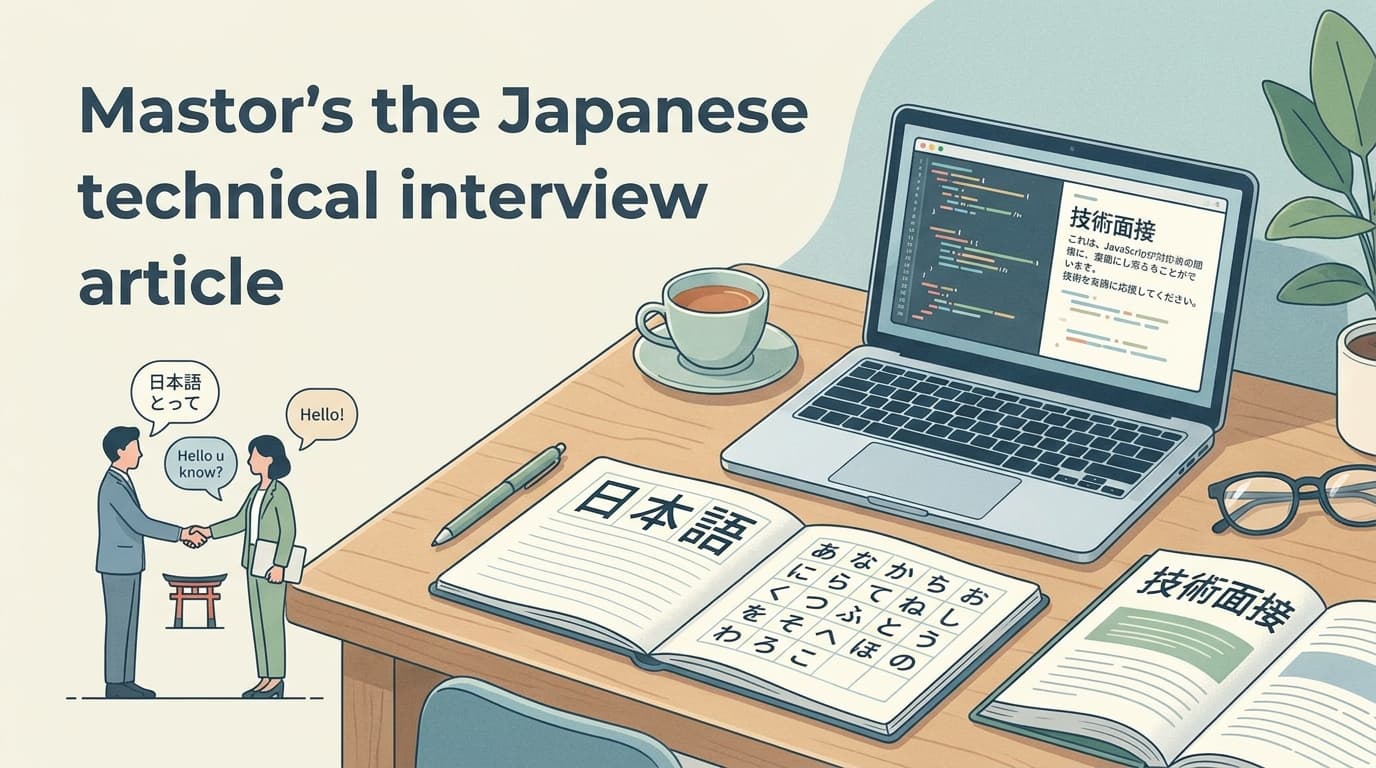
How to Prepare for a Japanese Technical Interview: Vocabulary and Etiquette
Navigating a technical interview in a foreign language is a high-pressure challenge that requires both professional linguistic precision and cultural nuance. The key to success lies in closing the gap between textbook Japanese and the actual, fast-paced language used in modern engineering and software development environments.
To bridge this gap, Corodomo provides a comprehensive toolkit for language learners who need to master real-world professional vocabulary. By allowing you to import your own technical training videos or browse existing content, Corodomo lets you generate bilingual subtitles that reveal how developers actually talk about their projects. Its CoroAI pronunciation tool and integrated dictionary help you rehearse technical explanations so you can speak with the confidence of a native professional, turning complex technical concepts into fluid conversation.
- The Basics of Japanese Interview Etiquette
- Essential Technical Vocabulary for Developers
- Communicating Complex Technical Concepts
- Using Video Content for Active Listening
- Refining Your Professional Persona
The Basics of Japanese Interview Etiquette
Japanese business culture is built on the concept of "Keigo," or honorific language. In a technical interview, you are not just being assessed for your coding skills, but for your ability to integrate into a Japanese team. First impressions are heavily dependent on your "ojigi" (bowing) and your command of humble and polite speech forms.
When entering the room, keep your movements deliberate. If it is a virtual interview, ensure your background is clean and your lighting is professional. Your language should lean toward "Sonkeigo" (respectful language) when talking about the interviewer's company and "Kenjougo" (humble language) when talking about your own experience.
Common etiquette markers include:
- Greeting the interviewer clearly before sitting down.
- Using "Desu/Masu" form consistently throughout the interview.
- Waiting to be prompted before explaining your salary expectations or career history.
- Using "Shitsurei shimasu" (Excuse me) when entering or leaving the room.
| Japanese Phrase | Reading | Meaning |
|---|---|---|
| 失礼します | Shitsurei shimasu | Excuse me (entering/leaving) |
| 面接 | Mensetsu | Job interview |
| 履歴書 | Rirekisho | Resume |
Essential Technical Vocabulary for Developers
Technical interviews involve a specific lexicon that is often borrowed from English but pronounced with Japanese phonetics. Knowing the correct "Katakana" English is crucial for clarity. You don't want to sound like you are speaking a different language than your interviewer.
For instance, terms like "server," "cloud," and "framework" are standard. However, you must also be comfortable with verbs that describe the development process, such as "kouchiku suru" (to build/construct) or "shusei suru" (to fix/correct). Familiarity with the Japanese dictionary is a non-negotiable step to ensuring you aren't just using the English word when a more specific Japanese compound verb exists.
Effective technical vocabulary practice:
- Categorize your technical stack into industry-standard Japanese terms.
- Practice explaining your past roles using the 仕事 (work) terminology.
- Focus on nouns related to the 勉 (study/diligence) and 学 (learning) aspects of your skills.
- Always verify if the technical jargon is preferred in Katakana or Kanji.
Example Sentence: サーバーの環境構築に興味があります。 (Saabaa no kankyou kouchiku ni kyoumi ga arimasu.) — I am interested in server environment construction.
Communicating Complex Technical Concepts
When explaining a challenging bug you fixed, use the "STAR" method (Situation, Task, Action, Result) adapted for Japanese. The focus in Japan is often on the process and the collaboration involved, not just the individual accomplishment. Avoid sounding too arrogant; instead, frame your achievements as the result of logical problem-solving.
Use transition words like "Dantiteki ni iu to" (to speak specifically) or "Jisseki to shite wa" (as for my track record). This helps the interviewer follow your logic through a technical narrative. If you are struggling with specific terms, don't be afraid to ask for clarification, as this shows professional humility.
- Structure your stories: State the problem, then your specific action, then the outcome.
- Avoid over-using English loanwords if a clear, professional Japanese alternative exists.
- Practice your pitch using Corodomo's AI tools to ensure your tone sounds professional, not casual.
- Record your answers to see if you are speaking too fast or too slowly.
Using Video Content for Active Listening
Passive study, like reading textbooks, will not prepare you for the speed of a live interview. You need to consume content that reflects how Japanese engineers describe their workflows. By using Corodomo to ingest YouTube technical tutorials or software engineering conference talks, you can isolate key phrases and study them in context.
The 勉強 (study) of technical language is most effective when it is active. Use the platform's quiz features to test your understanding of what was said in the video. When you listen to a developer explain an algorithm, pause and try to repeat the explanation back to the screen. This builds the "muscle memory" required for the high-pressure environment of an interview.
- Import 5-minute technical videos into Corodomo daily.
- Focus on identifying the "connective" phrases used by speakers to transition between technical steps.
- Use dictation tasks to sharpen your ear for fast-paced technical discussions.
- Analyze the subtitles to build your own custom vocabulary list for your upcoming interview.
Refining Your Professional Persona
Your "persona" is the collection of your posture, tone, and linguistic accuracy. During a Japanese technical interview, you want to convey "Shinrai" (trust/reliability). This is achieved through consistent, steady speech and an active, attentive listening style. When the interviewer is speaking, use "aizuchi" (nodding and small vocalizations like "Hai" or "Ee") to show you are following along.
Your ability to admit when you don't know something is also a professional skill. In Japanese, saying "Moushiwake arimasen, sono bunya ni tsuite wa chishiki ga fusoku shite imasu" (I am sorry, but my knowledge regarding that area is insufficient) is infinitely better than attempting to bluff and losing credibility.
- Practice maintaining eye contact while speaking.
- Develop a short "Jiko shoukai" (self-introduction) that lasts exactly 60 seconds.
- Prepare 3 polite questions to ask at the end of the interview.
- Ensure your technical terminology is consistent with the company's specific stack.
Frequently Asked Questions
How much should I rely on English terminology in a technical interview?
It depends on the company culture. Modern startups use more English, but traditional corporations prefer formal Japanese. It is best to use the standard Katakana for specific software tools (e.g., "Kuraudo" for Cloud) but use formal Japanese for verbs and structural explanations.
Is it acceptable to ask the interviewer to repeat the question?
Yes. Use the phrase "Mou ichido onegai dekimasu ka?" (Could you please say that one more time?). It is much better to ask for clarification than to answer the wrong question confidently.
How do I show passion without sounding aggressive?
In Japanese culture, passion is shown through persistence and a desire to learn. Mentioning your interest in a specific company product and your willingness to contribute to their team goals is more effective than aggressive self-promotion.
How can I improve my technical speaking speed?
Consistency is key. Use Corodomo to practice shadowing—where you listen to a technical video and repeat exactly what the speaker says at the same speed. This builds the rhythm needed for fluid, professional conversation.
Conclusion
Preparing for a technical interview in Japanese is a multifaceted process that goes beyond just coding. First, prioritize mastering formal business etiquette to show respect for the organization. Second, curate a deep bank of technical vocabulary so you can articulate your experience clearly. Finally, use active listening tools like Corodomo to bridge the gap between your current level and the professional standard required by Japanese firms. By focusing on these three areas, you will transform from a learner into a confident candidate capable of articulating your technical value in any Japanese-speaking office.
[Try Corodomo, in English]: [Learn languages, in English] · [Learn via Video, in English] · [Exam practice, in English]