
Ngôn ngữ
How to Learn Korean Online: Reach Fluency Fast from Home

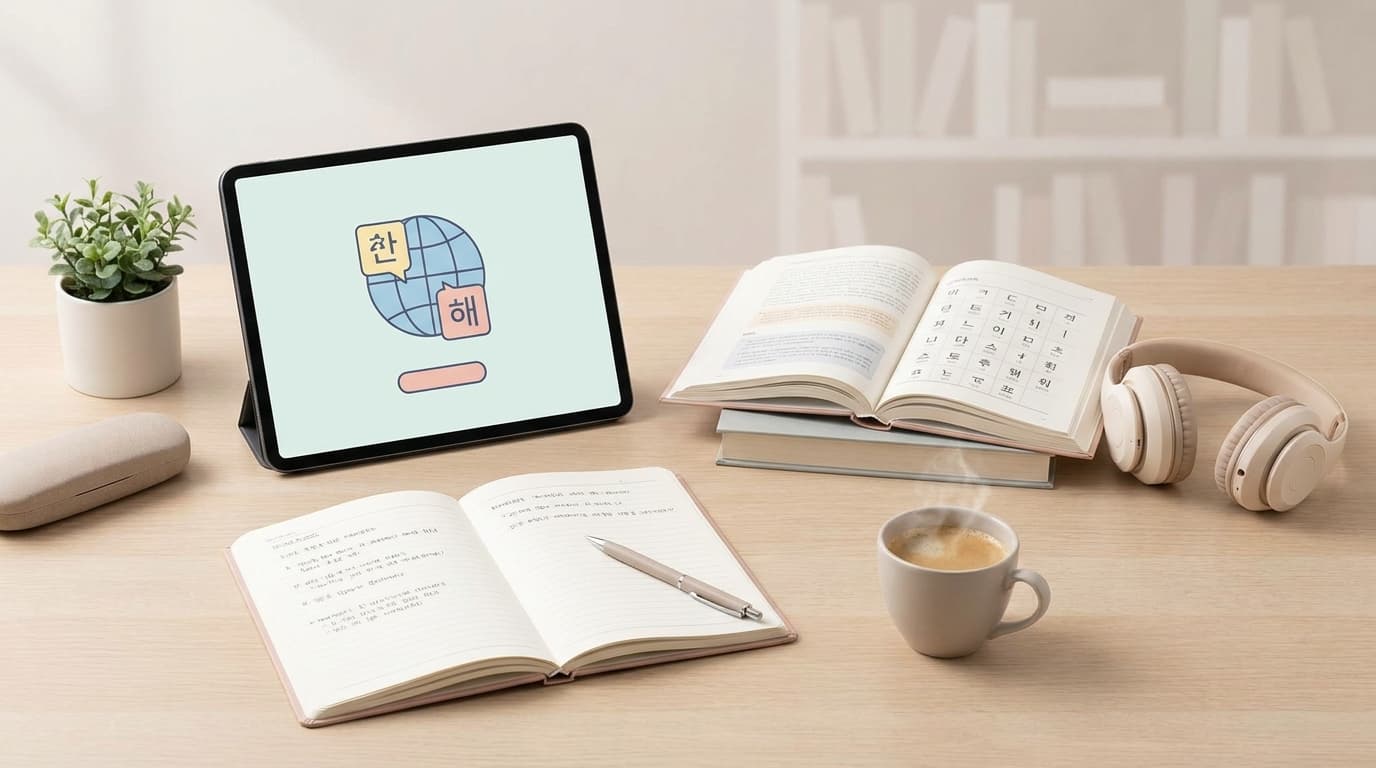
How to Learn Korean Online: Best Methods for Reaching Conversational Fluency From Home
Struggling to move beyond "hello" and "thank you" in your Korean studies? Reaching conversational fluency requires moving away from static textbooks and immersing yourself in the language's natural rhythm and context.
The secret to breaking through the intermediate plateau is active engagement with authentic content, which is exactly why Corodomo is a game-changer for self-learners. By allowing you to transform any YouTube video into an interactive lesson with auto-generated bilingual subtitles, Corodomo lets you bridge the gap between passive watching and active learning. With features like AI-powered word lookups, speaking practice via CoroAI, and comprehensive vocabulary testing, you can finally study Korean in a way that feels natural, addictive, and highly effective.
- Mastering Hangul: The Foundation
- The Power of Comprehensible Input
- Building Confidence Through Speaking
- Vocabulary Retention and Spaced Repetition
- Advanced Listening and Dictation
- Frequently Asked Questions
Mastering Hangul: The Foundation
Many learners make the mistake of relying on Romanization to read Korean. While it might seem easier at first, it actually acts as a crutch that prevents you from developing a native-like accent and proper reading speed. Hangul, the Korean alphabet, is one of the most logical writing systems in the world, designed to be learned in a single afternoon.
Focus on understanding the phonetic structure of the blocks. Hangul is not just a string of letters; it is a system of blocks that group consonants and vowels together. When you learn to read these blocks, your brain starts to recognize patterns rather than individual characters, significantly speeding up your reading comprehension later on.
- Use a dedicated Hangul chart to practice pronunciation daily.
- Avoid Romanization entirely after the first week of study.
- Focus on the shape of your mouth when pronouncing vowels; Korean vowels are highly distinct.
| Hangul | Reading | Meaning |
|---|---|---|
| 안녕하세요 | an-nyeong-ha-se-yo | Hello |
| 감사합니다 | gam-sa-ham-ni-da | Thank you |
The Power of Comprehensible Input
Comprehensible input is the theory that you learn a language best when you consume content that is just slightly above your current level. In the past, this meant buying expensive graded readers. Today, you have access to thousands of hours of native content on platforms like YouTube.
However, simply watching videos isn't enough. You need to understand what is being said. By using Corodomo, you can upload videos you find interesting—whether they are K-dramas, cooking shows, or vlogs—and receive instant bilingual subtitles. This turns a passive activity into a high-intensity study session where you can check the meaning of any word instantly.
- Choose content that matches your interests to keep your motivation high.
- Watch short clips multiple times rather than long videos once.
- Use the AI word lookup to identify recurring vocabulary in your favorite videos.
가다 (ga-da) – To go
먹다 (meok-da) – To eat
보다 (bo-da) – To see/watch
Building Confidence Through Speaking
The biggest hurdle for most learners is the "speaking barrier." You might understand a sentence perfectly when you hear it, but struggle to produce the same sound yourself. This is usually due to a lack of muscle memory in your mouth and throat.
You don't need a live tutor to improve your pronunciation. Modern tools like CoroAI allow you to practice speaking without the social pressure of a live conversation. You can mimic the intonation of native speakers in your videos and receive instant feedback on your performance. This is the most efficient way to iron out your accent from the comfort of your home.
- Record yourself speaking and compare it to the original video audio.
- Focus on "shadowing," where you speak along with the audio in real-time.
- Don't worry about perfect grammar initially; prioritize flow and rhythm.
Vocabulary Retention and Spaced Repetition
Learning 100 words today is useless if you forget them by next week. The secret to long-term memory is spaced repetition. You need to review words just as you are about to forget them. This is why flashcards and vocabulary testing are essential components of any successful learning routine.
When you encounter a new word in a video, save it to your deck immediately. Use a system that tests you in different ways: recognizing the meaning, typing the reading, and even writing out example sentences. This multi-layered approach ensures that you aren't just memorizing definitions, but actually learning how to use the words in context.
- Aim to learn 5-10 new words per day rather than 50 at once.
- Contextualize your vocabulary; learn words as part of a phrase, not in isolation.
- Use the four types of vocabulary tests (meaning, listening, reading, writing) to solidify your knowledge.
| Vocabulary | Type | Usage |
|---|---|---|
| 공부하다 | Verb | To study |
| 친구 | Noun | Friend |
Advanced Listening and Dictation
Listening is the final piece of the puzzle. It is the hardest skill to master because native speakers often drop sounds or speak at a speed that feels impossible to follow. Dictation—the process of listening to a sentence and writing it down exactly as you hear it—is the "gold standard" for improving this skill.
By using the dictation features available in tools like Corodomo, you force your brain to process every syllable. You will notice that you often miss particles or small grammar markers. Dictation highlights these blind spots, allowing you to refine your listening until you can catch every nuance of a native speaker’s sentence.
- Start with very short, slow sentences.
- Listen to the sentence 3-5 times before attempting to write it down.
- Check your spelling against the original subtitle for accuracy.
Frequently Asked Questions
How long does it take to become fluent in Korean?
Fluency is subjective, but for an English speaker, reaching a conversational level usually takes about 1,000 to 2,000 hours of dedicated, consistent study. It is a marathon, not a sprint.
Is it possible to learn Korean without a teacher?
Yes, especially today. With AI tools, language platforms, and a wealth of free video content, you have more resources than a student would have had in a classroom 20 years ago.
Should I focus on grammar or vocabulary first?
Balance is key. Grammar provides the structure, but vocabulary is the content. If you have to choose, prioritize high-frequency vocabulary and basic sentence structures first to start expressing yourself sooner.
How do I stay motivated when learning gets hard?
Focus on "fun" input. If you are bored, you will quit. Use videos about your hobbies—whether that’s gaming, fashion, or tech—to make your study time feel like leisure time.
Conclusion
Reaching conversational fluency in Korean is an achievable goal if you follow a structured, consistent path. Remember these three key takeaways: first, build a strong foundation with Hangul and avoid the crutch of Romanization. Second, embrace comprehensible input by watching authentic video content that you actually enjoy. Finally, use active tools like Corodomo to practice speaking, dictation, and vocabulary retention through spaced repetition. By making these methods a part of your daily routine, you will bridge the gap between "learner" and "speaker" faster than you ever thought possible.
[Try Corodomo, in English]: [Learn languages, in English] · [Learn via Video, in English] · [Exam practice, in English]