
Ngôn ngữ
Learn English Online: Fix R and L with Video Mimicry

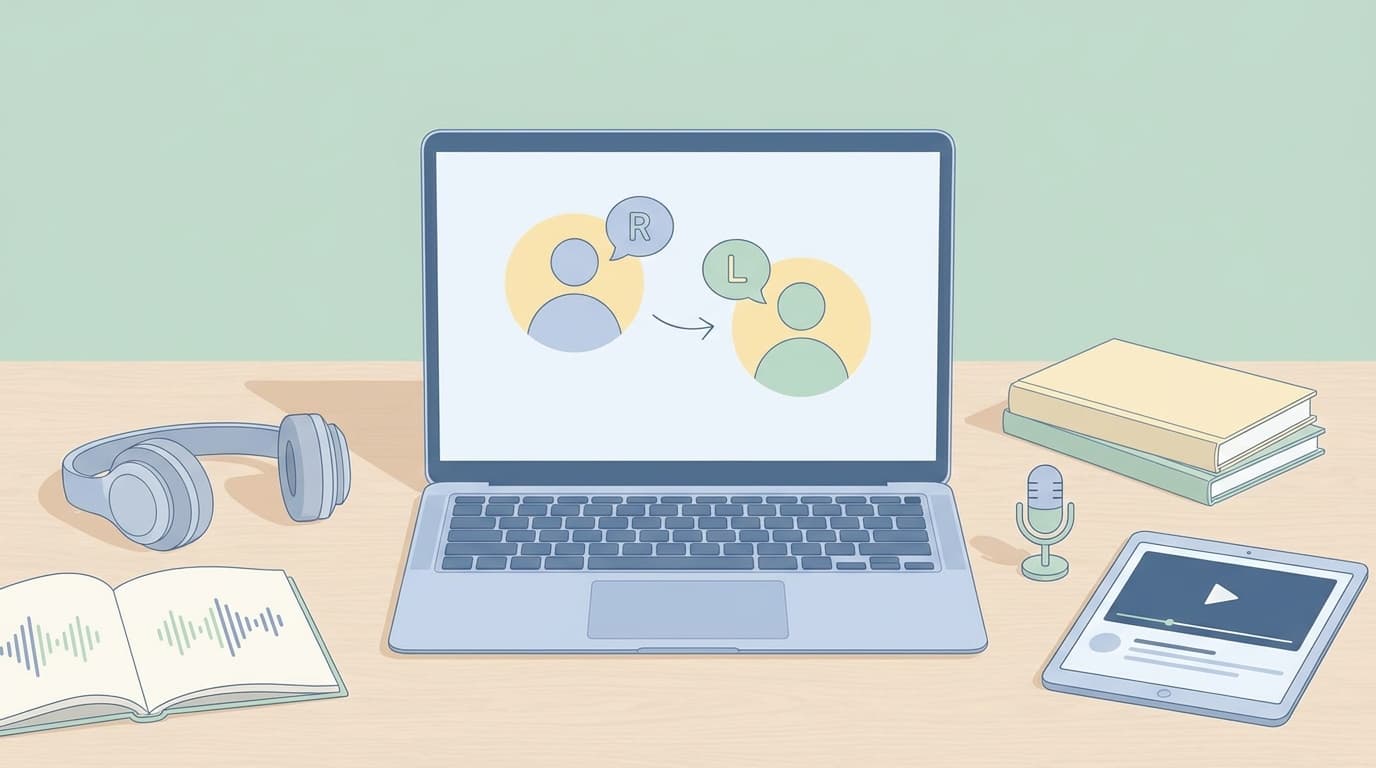
Learn English Online: Fixing the 'R' and 'L' Confusion with Video Mimicry
Struggling to distinguish between the 'R' and 'L' sounds is a common hurdle for many learners, leading to frustration when your pronunciation doesn't match your intentions. By integrating active mimicry into your daily routine, you can train your ears and tongue to overcome this phonetic barrier effectively.
To bridge the gap between passive listening and active speaking, Corodomo provides a unique environment for language learners to practice these tricky sounds. By leveraging bilingual video content, you can isolate specific segments where native speakers emphasize these phonemes, allowing you to slow down the audio, record your own version with CoroAI, and receive immediate feedback. Whether you are navigating the nuances of German phonetics or perfecting English articulation, Corodomo lets you turn any video into a personalized pronunciation workshop, ensuring you build confidence through real-world context.
- Understanding the R and L Phonetic Divide
- The Power of Visual Cues in Video Learning
- Active Mimicry: From Watching to Speaking
- Using AI to Bridge the Pronunciation Gap
- Building a Sustainable Daily Practice Habit
- Frequently Asked Questions
Understanding the R and L Phonetic Divide
The confusion between 'R' and 'L' often stems from the fact that both sounds are "liquids" in linguistics, meaning the tongue position is relatively similar but the interaction with the roof of the mouth changes. In English, the 'L' requires the tongue to touch the alveolar ridge, while the 'R' sound, specifically the American English 'R', is retroflex, meaning the tongue curls back slightly without touching the roof.
For learners coming from languages where these sounds might be mapped to a single phoneme, the distinction feels invisible. You aren't just learning a sound; you are retraining your brain to categorize acoustic data differently. The key is to stop thinking about how the word looks on a page and start focusing on the physical placement of your tongue, teeth, and lips during articulation.
Consider the difference in these common English word pairs:
| Word Pair | Phonetic Focus | Meaning |
|---|---|---|
| Light vs. Right | Initial consonant | Illumination vs. Direction |
| Climb vs. Crime | Medial consonant | To ascend vs. Illegal act |
| Flee vs. Free | Consonant cluster | To run away vs. Without cost |
To improve, try these actionable steps:
- Identify the specific words that trip you up most frequently.
- Use a mirror to observe your mouth while mimicking native speakers.
- Focus on the "tension" of the tongue: 'L' is relaxed, while 'R' involves more muscular engagement.
The Power of Visual Cues in Video Learning
Why do we often struggle with pronunciation when using audio-only methods? It is because we are missing the visual feedback of the speaker's face. When you watch a native speaker, you can see how the jaw drops, how the lips round for an 'R', and how the tongue peaks for an 'L'. This visual data is crucial for motor-skill acquisition.
Video-based learning allows you to see the "hidden" mechanics of speech. By using platforms like Corodomo, you can select videos that feature close-ups of native speakers. This allows you to pause at the exact moment a word starting with 'R' or 'L' is articulated, giving you a chance to emulate the mouth shape before you even attempt to make the sound.
Try this exercise:
- Find a short clip of a news anchor or a clear narrator.
- Turn the volume down and watch just the mouth movements of the speaker.
- Predict when they are saying an 'R' or 'L' based purely on the visual cues.
- Replay the clip with audio to confirm your predictions.
Active Mimicry: From Watching to Speaking
Active mimicry goes beyond simple repetition; it is an imitation game. To truly fix your pronunciation, you must adopt the rhythm, pitch, and energy of the speaker. This is where most learners fail—they try to "read" the language aloud rather than "perform" it as a native speaker would.
Start by breaking down a sentence into smaller chunks. Don't just mimic the sound; mimic the emotion. When you perform the sound, exaggerate it at first. If you are learning Japanese and practicing the 勉強 (benkyou - study) concept, ensure your 'b' and 'n' sounds are clean, even if they aren't 'R' or 'L', to maintain consistent mouth positioning.
{Right} – {raɪt} – {Correct or direction}
Follow these tips for effective mimicry:
- Record yourself using the record feature on your learning platform.
- Listen to the original audio, then play your recording immediately after.
- Compare the two: notice if your 'R' sounds too much like an 'L'.
- Repeat the process until the gap between your version and the original closes.
Using AI to Bridge the Pronunciation Gap
The introduction of AI into language learning has changed the game for self-learners. You no longer need to wait for a teacher to correct you; you have immediate access to an intelligent listener. Modern AI can analyze your pitch and articulation to tell you exactly where your sound deviates from a native speaker.
When you use tools like Corodomo, you aren't just guessing if your pronunciation is correct. The AI provides quantitative feedback on your speaking efforts. This is particularly helpful for 'R' vs 'L' because these sounds are often subtle enough that a human friend might be too polite to point out your mistakes, but an AI will catch every instance.
- Use dictation exercises to test your listening first; if you can't hear the difference, you can't say it.
- Focus on "typing the reading" to reinforce the mental mapping of the sound to the character or word.
- Engage in regular speaking practice sessions where the AI scores your clarity.
Building a Sustainable Daily Practice Habit
Pronunciation is not a skill you master in a weekend; it is built through consistent micro-habits. Spending 15 minutes a day with targeted video exercises is significantly more effective than a three-hour cram session once a week. The goal is to keep your mouth muscles active and your ears sensitive to phonetic shifts.
Make it easy for yourself by building your "playlist" of videos that contain the vocabulary you need to master. If you are focusing on professional language, look for videos discussing 仕事 (shigoto - work). Even if the word doesn't contain 'R' or 'L', the surrounding context helps you maintain a natural flow and cadence that makes your overall speech more authentic.
- Set a specific time of day for your 15-minute "pronunciation deep dive."
- Select one "anchor word" each day that features the target sound.
- Track your progress by recording a "before and after" clip every week to see your improvement.
Frequently Asked Questions
How long does it take to fix the R and L confusion?
Improvement is incremental. While you might notice better mouth positioning in just a few days, solidifying the muscle memory usually takes several weeks of consistent, daily practice.
Can I learn by just listening without recording myself?
Listening is only half the battle. Recording yourself is essential because you need to hear your voice from an external perspective to catch the subtle errors that you might miss while speaking.
Is it easier to learn English or German if I have this confusion?
Both languages present challenges, but they utilize different mouth shapes. Focusing on visual mimicry through video is the most efficient way to overcome the specific phonetic hurdles of any target language.
Should I use slow-motion video when practicing?
Yes, especially when you are first learning the tongue position. Slowing down the video helps you isolate the consonant and observe exactly where the tongue is placed in relation to the teeth.
Conclusion
Overcoming the 'R' and 'L' confusion is a milestone in your language journey that signals a shift from "studying" to "speaking." Remember these three key points: use visual cues from native speakers to guide your mouth position, leverage AI technology to get objective feedback on your progress, and prioritize daily, short practice sessions to build lasting muscle memory. By using a platform like Corodomo, you can make this process intuitive and integrated into your daily life, ensuring you reach your fluency goals with confidence.
[Try Corodomo, in English]: [Learn languages, in English] · [Learn via Video, in English] · [Exam practice, in English]