
Ngôn ngữ
Master English Vowel Length & Schwa for Korean Speakers

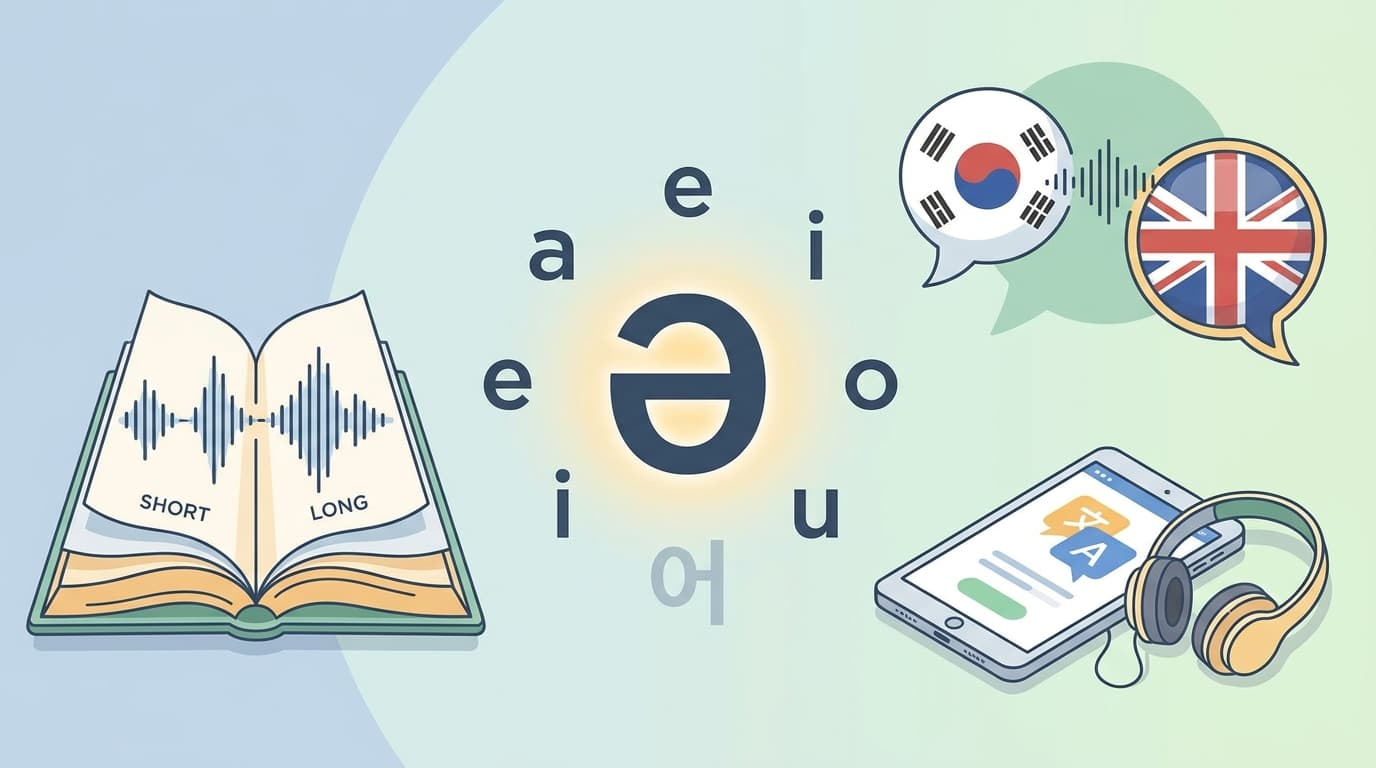
Learn English Online for Korean Speakers: Mastering Vowel Length and Schwa for Clear Communication
Korean speakers often struggle with English vowel length and the schwa because Korean does not distinguish vowel duration in the same way. By understanding these two features, you can make your English much clearer and more natural.
English has more vowel sounds than Korean, and two features in particular — vowel length and the reduced schwa sound — carry meaning. Saying ship instead of sheep or stressing every syllable equally can lead to misunderstandings. The good news is that with focused listening and repetition, you can train your ear and mouth to produce these sounds accurately. Corodomo makes this process easier by letting you learn directly through video content: paste a YouTube link or upload a video, and the platform generates bilingual subtitles so you can see and hear vowel contrasts in real contexts. With tools like AI word lookup, pronunciation practice, and dictation exercises, you can work on vowel length and schwa in a way that sticks.
- Why English Vowels Are Challenging for Korean Speakers
- Understanding the Schwa: English's Most Common Sound
- Mastering Vowel Length: Short vs. Long Vowels
- Practical Drills for Vowel Length and Schwa
- Using Video and AI Tools to Perfect Your Pronunciation
- Common Word Pairs to Practice
- Frequently Asked Questions
- Conclusion
Why English Vowels Are Challenging for Korean Speakers
Korean has only eight vowel phonemes, while English has around fourteen to twenty, depending on the dialect. This mismatch means that several English vowel sounds map to the same Korean vowel in a Korean speaker's mind. For example, English bit and beat sound similar to a Korean ear because Korean does not distinguish between short and long vowels with the same quality.
Another major difference is syllable timing. Korean is a syllable-timed language, which means each syllable takes roughly the same amount of time. English, by contrast, is stress-timed: stressed syllables are longer, and unstressed syllables are reduced and shortened. This rhythm is essential for natural-sounding English, and it directly involves the schwa sound.
Korean also lacks the lax vowels found in English, such as the short /ɪ/ in sit and the /ʊ/ in look. These vowels require a more relaxed tongue and lip position than Korean speakers are used to. The good news is that these are learnable skills with consistent practice.
- Vowel quality vs. length: English uses both to distinguish words; Korean primarily uses quality.
- Stress timing: English reduces unstressed vowels; Korean keeps them full.
- New tongue positions: Lax vowels require a more relaxed mouth posture.
Example contrast:
ship – /ʃɪp/ – short, lax vowel
sheep – /ʃiːp/ – long, tense vowel
Korean gloss: ship = 배 (bae), sheep = 양 (yang) — but the vowel length distinction changes the word entirely.
Understanding the Schwa: English's Most Common Sound
The schwa /ə/ is the most frequent vowel sound in spoken English. It appears in unstressed syllables, such as the first syllable of about (ə-ˈbaʊt) and the last syllable of sofa (ˈsoʊ-fə). It is a neutral, central sound made with the tongue in a relaxed, mid-central position. For Korean speakers, this sound does not exist in the native vowel inventory, which makes it easy to overlook.
Because Korean does not reduce vowels in unstressed syllables, Korean speakers tend to pronounce every vowel clearly. This results in a choppy, overly precise rhythm that sounds foreign to native English ears. The schwa is the key to sounding more natural because it creates the characteristic rise and fall of English stress patterns.
To produce the schwa, relax your jaw and lips completely. The sound is like a quick, weak uh. Try saying the word banana: the first and third vowels are schwas, while the second is stressed. Korean speakers often pronounce all three a sounds the same, but in natural English, only the middle one is clear.
- Common schwa words: about, again, America, problem, support
- Schwa in multi-syllabic words: the second syllable of photograph is a schwa
- Function words: to, for, from, of are often reduced to schwa in connected speech
Example:
photograph – /ˈfoʊ.t̬ə.ɡræf/ – the second vowel is a schwa
Korean gloss: 사진 (sajin) — but the English pronunciation reduces the middle vowel.
Mastering Vowel Length: Short vs. Long Vowels
In English, vowel length is not just a matter of duration; it is tied to vowel quality. Long vowels are tense, meaning the tongue and lips are more engaged, while short vowels are lax and more relaxed. For Korean speakers, the distinction between bit /bɪt/ and beat /biːt/ is challenging because both vowels might map to the same Korean vowel /i/.
Listen closely to minimal pairs. Live and leave, full and fool, cot and caught — these pairs differ primarily in vowel length and tension. In Korean, vowel length was historically contrastive but is no longer a prominent feature of modern Seoul Korean, so the distinction can feel unnatural at first.
A practical way to practise is to exaggerate the length of the long vowel at first. Say sheep with a very long /iː/ and then ship with a short, clipped /ɪ/. Your mouth should feel more open and relaxed for the short vowel. Over time, the duration difference becomes automatic.
- Short vowels: /ɪ/ as in sit, /ʊ/ as in book, /ɛ/ as in bed
- Long vowels: /iː/ as in seat, /uː/ as in boot, /ɑː/ as in father
- Diphthongs: /eɪ/ as in say, /aɪ/ as in my — these are inherently long
Minimal pair table:
Short IPA Long IPA Korean gloss ship /ʃɪp/ sheep /ʃiːp/ 배 / 양 live /lɪv/ leave /liːv/ 살다 / 떠나다 full /fʊl/ fool /fuːl/ 가득한 / 바보 cot /kɒt/ caught /kɔːt/ 침대 / 잡히다
Practical Drills for Vowel Length and Schwa
Drills are most effective when you combine listening, speaking, and self-monitoring. Start with minimal pairs. Read each pair aloud, paying close attention to the duration and tension of the vowel. Record yourself and compare with a native speaker model. You can find model pronunciations on Corodomo through its AI-powered word lookup, which gives you both the phonetic transcription and audio.
For the schwa, practise reducing function words in sentences. Take a sentence like I have to go to the store. In natural speech, have to becomes /ˈhæf.tə/ and to becomes /tə/. The schwa appears in both to and the second syllable of store is not a schwa — actually store has no schwa. A better example: I want to go to the park — the to before go and park often reduces to schwa.
Another effective drill is shadowing. Choose a short video clip of a native English speaker, ideally from a news broadcast or a conversation. Play a sentence, pause, and repeat it while mimicking the stress and reduction patterns. Corodomo supports video-based shadowing with bilingual subtitles, so you can see the reduced words highlighted while you listen.
- Minimal pair drill: 5 minutes daily, saying pairs aloud
- Schwa spotting: Take a paragraph and circle every schwa sound
- Shadowing: Repeat after a native speaker, matching their rhythm
- Recording: Compare your pronunciation with a model
Drill example:
Say each pair five times, holding the long vowel for two seconds:
bit – beat · hit – heat · sit – seat
Korean gloss: bit = 조금, beat = 때리다 / hit = 치다, heat = 열 / sit = 앉다, seat = 자리
Using Video and AI Tools to Perfect Your Pronunciation
Video is an ideal medium for pronunciation practice because it provides both auditory and visual cues. You can watch how native speakers shape their mouths, and you can hear the rhythm of connected speech. The Corodomo platform turns any YouTube video into a language lesson by generating bilingual subtitles, so you can watch content you already enjoy while actively working on vowel sounds.
One powerful feature is the AI Q&A that understands the video's content. You can ask questions like "How does the speaker pronounce 'about'?" and the AI can guide you to the relevant timestamp. The pronunciation and speaking practice tool, CoroAI, gives you feedback on your own production, helping you adjust vowel length and schwa placement in real time.
For vowel length, try watching a cooking show or a vlog. Pay attention to words like cook vs. kook or ship vs. sheep — these often appear in everyday contexts. With bilingual subtitles from Corodomo, you can see the Korean translation alongside the English, which helps you notice when a single Korean word corresponds to two different English vowel sounds. The dictation feature also sharpens your listening: type what you hear, and the system checks your accuracy, pushing you to hear the subtle length differences.
- Use video content you love: Movies, vlogs, documentaries
- Enable bilingual subtitles: Compare English and Korean side by side
- Ask AI questions: Query specific pronunciation points
- Use dictation: Type what you hear to test your listening
Example video drill:
Find a clip with the word career /kəˈrɪr/. Notice the first vowel is a schwa. The Korean equivalent, 경력 (gyeongnyeok), does not have a schwa. Mimic the reduced first syllable.
Common Word Pairs to Practice
Focused practice on specific word pairs helps you internalise the vowel length and schwa distinctions. Below is a list of high-frequency pairs that Korean speakers often confuse. Practice them in sentences, not just in isolation, because the surrounding words affect stress and reduction.
For each pair, create a short dialogue. For example, with live and leave: "I live in Seoul, but I will leave for Busan tomorrow." The contrast between the short /ɪ/ and long /iː/ becomes clearer in context. Notice also how for in that sentence is reduced to /fər/ — a schwa!
| Short vowel word | IPA | Long vowel word | IPA | Korean meaning |
|---|---|---|---|---|
| sit | /sɪt/ | seat | /siːt/ | 앉다 / 자리 |
| look | /lʊk/ | Luke | /luːk/ | 보다 / 루크 (이름) |
| not | /nɒt/ | naught | /nɔːt/ | 아니다 / 제로 |
| pull | /pʊl/ | pool | /puːl/ | 당기다 / 수영장 |
| fill | /fɪl/ | feel | /fiːl/ | 채우다 / 느끼다 |
For schwa practice, focus on multi-syllabic words where the schwa appears in unstressed positions. Words like comfortable /ˈkʌm.fɚ.t̬ə.bəl/ have two schwas. The Korean translation, 편안한 (pyeonanhan), has full vowels throughout, so you need to consciously reduce the English version.
Schwa-heavy sentence:
The photographer took a photograph of the family.
IPA: /ðə fəˈtɒɡ.rə.fər tʊk ə ˈfəʊ.tə.ɡrɑːf əv ðə ˈfæm.ɪ.li/
Korean gloss: 사진작가가 가족의 사진을 찍었다.
Notice the schwas in the, photographer, a, and of.
Frequently Asked Questions
Why does English have so many vowel sounds compared to Korean?
English developed from a mix of Germanic and Romance languages, which resulted in a larger vowel inventory. Korean, by contrast, evolved with a smaller set of vowel phonemes. The extra English vowels often carry meaning, so learning them is essential for clear communication.
Can I learn vowel length just by listening to native speakers?
Listening is crucial, but active practice is equally important. Shadowing, recording, and getting feedback through tools like Corodomo's pronunciation practice accelerate progress. Passive listening alone is not enough to reshape your muscle memory.
Is the schwa sound really that important?
Yes. The schwa appears in nearly every English sentence. Without it, your speech will sound choppy and foreign. Mastering the schwa is one of the fastest ways to sound more natural and reduce listener effort.
How can I tell if I am pronouncing a vowel long enough?
Record yourself and compare the duration to a native speaker using a waveform tool. A simpler method: listen for the tension. Long vowels are longer but also feel more "stretched" in the mouth. If your mouth is relaxed, you are likely producing a short vowel.
What is the best type of video to practise with?
Choose content with clear, slow speech, such as news broadcasts, documentaries, or educational YouTube channels. Avoid fast, heavily accented speech at first. Corodomo lets you paste any YouTube link and generate bilingual subtitles, so you can pick content that matches your level and interests.
Conclusion
Mastering English vowel length and the schwa is a journey, but it is one that pays off in clarity and confidence. The three most important takeaways are: first, English uses both vowel quality and length to distinguish words, unlike Korean; second, the schwa is the backbone of natural English rhythm and appears in almost every sentence; and third, consistent, focused practice with listening, shadowing, and feedback is the only path to improvement.
With tools like Corodomo, you can integrate pronunciation practice into your daily video-watching routine. Bilingual subtitles, AI word lookup, speaking practice, and dictation exercises all work together to help you hear and produce these sounds more accurately. Start with one word pair today — ship and sheep — and build from there. Every small improvement brings you closer to clear, natural English.
Try Corodomo today: Learn English online · Learn via video · Pronunciation practice