
Ngôn ngữ
English Shadowing Practice: Speak Clearly with Videos

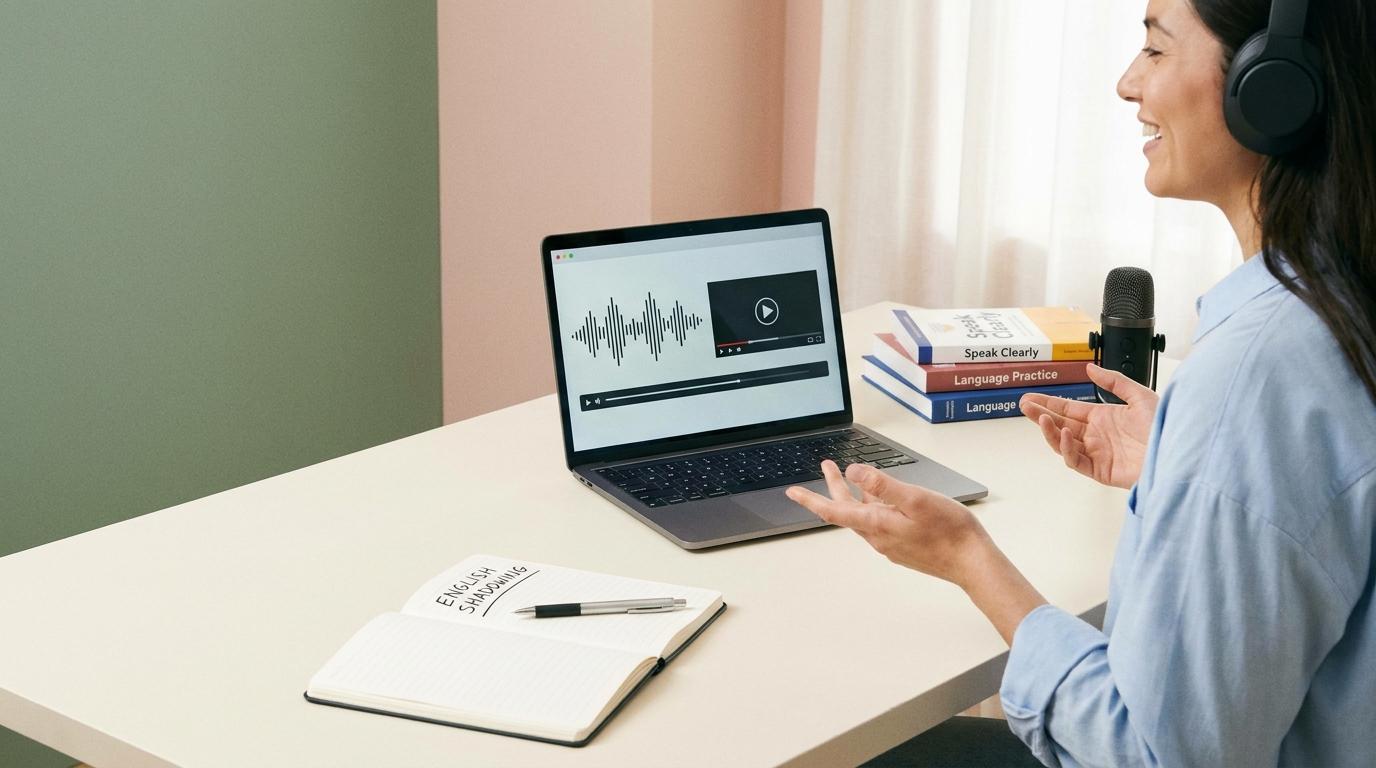
English Shadowing Practice: Improve Pronunciation, Fluency, and Listening with Short Videos
Shadowing is simple, but many learners do it too casually and see little progress. With the right video, timing, and feedback loop, you can turn five minutes into focused pronunciation, fluency, and listening practice.
- What English Shadowing Practice Means for Language Learners
- How to Choose Short Videos That Actually Help
- A Five-Step Shadowing Routine for Busy Learners
- How to Use Shadowing for Pronunciation and Fluency
- How to Turn Shadowing into Listening and Vocabulary Growth
- How Corodomo Makes Video Shadowing Easier
- FAQ
- Conclusion
What English Shadowing Practice Means for Language Learners
English shadowing practice means listening to a short piece of speech and speaking along with it, almost like your voice is a shadow. The phrase often appears in English-learning contexts, but the method works for Japanese, Chinese, Korean, German, English, and many other languages. If you are a native English speaker learning a foreign language, shadowing gives you a way to train your ear and mouth together.
The key difference between shadowing and normal repeating is timing. In simple repetition, you listen first and speak after the audio stops. In shadowing, you speak during the audio, usually half a second behind. This forces you to notice rhythm, sentence stress, connected speech, and natural pauses. You are not only memorizing words. You are copying how real speech moves.
Shadowing is especially useful for busy self-learners because it does not require a long study session. A 20-second video clip can become a complete pronunciation workout. You can replay it, read bilingual subtitles, look up unknown words, record yourself, and test the vocabulary. Short videos also keep motivation high because the task feels finishable.
Do not worry if your first attempts feel chaotic. Shadowing is not a performance test. It is a training drill. At first, you may only catch the final word of each sentence. Then you may catch chunks. Later, you will copy intonation and emotion. Progress comes from repeating the same short clip with a clear purpose.
- Start with clips between 10 and 45 seconds, not full episodes or long lectures.
- Choose speech that is clear, natural, and interesting enough to repeat several times.
- Shadow one speaker at a time, especially at the beginner and intermediate levels.
- Use subtitles as support, but do not stare at them during every repetition.
- Focus on sound first, then meaning, then speed.
| Language | Example | Reading | Meaning |
|---|---|---|---|
| Japanese | 勉強します | べんきょうします | I study |
| Chinese | 我想练习发音 | wǒ xiǎng liànxí fāyīn | I want to practice pronunciation |
| Korean | 천천히 말해 주세요 | cheoncheonhi malhae juseyo | Please speak slowly |
| German | Ich verstehe ein bisschen | ikh fair-SHTAY-uh ine BIS-khen | I understand a little |
How to Choose Short Videos That Actually Help
The best shadowing video is not always the most entertaining one. It is the clip that matches your current level and contains speech you can realistically imitate. If every sentence has five unknown words, your brain will spend all its energy decoding meaning. If the clip is too easy, you may repeat it without improving your pronunciation or listening.
Look for videos with everyday speech, strong context, and visible emotion. Short interviews, travel clips, cooking videos, language teacher shorts, drama scenes, and vlogs can work well. Context matters because it helps you guess meaning before checking a dictionary. A speaker pointing at food, greeting a customer, or explaining a routine gives you clues that pure audio does not provide.
For Japanese, Chinese, Korean, and German, beginners should avoid extremely fast comedy, heavy dialect, and overlapping conversation at first. These are valuable later, but they can overload you early. Intermediate learners can use them in small doses. Advanced learners should include messy real speech because real listening is rarely perfectly scripted.
A good rule is the “70 percent comfort” test. Before deep study, watch the clip once. If you can understand the situation and catch some words, it is usable. If you understand almost nothing, save it for later. If you understand everything immediately, use it for speed, accent, and natural delivery rather than vocabulary.
- Pick videos with one main speaker and clear audio.
- Prefer clips with repeated phrases, questions, reactions, or daily actions.
- Use bilingual subtitles when possible, especially for Chinese characters or Japanese kanji.
- Avoid clips with loud music under the voice during focused shadowing.
- Create a “shadowing queue” of five clips, so you never waste study time searching.
Japanese: 今日は仕事です – きょうはしごとです – Today I have work. This is a useful shadowing sentence because it has natural rhythm, common vocabulary, and a clear daily-life context.
When you find a sentence like 今日は仕事です, do not only translate it. Listen for the pitch and timing. Japanese does not stress words like English does. The sentence may sound flatter than an English speaker expects. If you want to explore the word 仕事 in context, a detailed lookup such as Corodomo’s Japanese word page for 仕事 can help you connect meaning, reading, and examples.
A Five-Step Shadowing Routine for Busy Learners
A practical routine matters more than motivation. Many learners watch videos and think they are studying, but passive watching creates weak results. Shadowing works when each replay has a job. You should know whether you are listening for meaning, copying sounds, recording yourself, or testing recall.
Use this five-step routine with one short video. It can take five minutes on a busy day or 20 minutes when you have more time. The goal is not to finish many videos. The goal is to squeeze high-quality practice out of a small amount of speech. One excellent 30-second clip can teach pronunciation, grammar, listening, and vocabulary.
Step one is preview. Watch once without pausing. Step two is meaning. Check bilingual subtitles and look up important words. Step three is slow shadowing. Speak with the audio at a comfortable speed or sentence by sentence. Step four is live shadowing. Follow the speaker with minimal delay. Step five is recall. Hide the subtitles and summarize or repeat key sentences from memory.
If you are tired, do only steps one to three. If you are preparing for a speaking test or real conversation, do all five and record yourself. Recording feels uncomfortable, but it is one of the fastest ways to notice problems. You may discover that you drop endings in German, flatten tones in Chinese, or add English stress to Japanese and Korean.
- Preview once without pausing, even if you miss details.
- Underline or save only three to seven useful words from the clip.
- Shadow slowly before trying to match full native speed.
- Record one final attempt, then compare it to the original.
- End by saying one new sentence without audio support.
| Step | Action | Example Sentence |
|---|---|---|
| Preview | Watch for the situation | 何をしていますか – なにをしていますか – What are you doing? |
| Meaning | Check words and translation | 저는 한국어를 공부해요 – jeoneun hangugeoreul gongbuhaeyo – I study Korean |
| Shadow | Speak with the audio | Ich lerne jeden Tag – ikh LAIR-nuh YAY-den tahk – I study every day |
For Japanese learners, words based on study are worth saving because they appear constantly in routines and self-introductions. You can review 勉強 and the kanji 勉 if you want to connect the spoken word べんきょう with its written form.
How to Use Shadowing for Pronunciation and Fluency
Pronunciation is not only individual sounds. It includes timing, pitch, stress, reductions, pauses, and confidence. Shadowing helps because it trains whole phrases rather than isolated syllables. This is important for native English speakers because English rhythm can interfere with other languages. You may pronounce each sound correctly but still sound unnatural if the rhythm is too English-like.
For Japanese, watch for mora timing. A word like 学校, がっこう, has a held consonant and long vowel. For Chinese, tones must stay clear inside the sentence, not only in single-word drills. For Korean, pay attention to sound changes between words. For German, final consonants and vowel length can change meaning. In English as a foreign language, learners often need stress and reduction practice, such as “want to” becoming “wanna” in casual speech.
Fluency improves when your mouth learns common chunks. A chunk is a ready-made phrase such as “I think that,” “please give me,” or “I have to go.” In another language, these chunks reduce the mental load of speaking. You no longer build every sentence from scratch. Shadowing builds these chunks with natural rhythm attached.
To practice pronunciation deeply, choose one target per clip. Do not try to fix every sound at once. On Monday, focus on Japanese long vowels. On Tuesday, focus on Mandarin third tones. On Wednesday, focus on Korean sentence endings. This keeps practice measurable and prevents frustration.
- Circle one pronunciation feature before shadowing the clip.
- Clap or tap the rhythm before speaking if the sentence feels difficult.
- Imitate the speaker’s emotion, not just the words.
- Over-copy at first; naturalness often comes after exaggeration.
- Compare your recording for rhythm before judging individual sounds.
| Focus | Example | Reading | Meaning |
|---|---|---|---|
| Japanese long vowel | 学校に行きます | がっこうにいきます | I go to school |
| Chinese tones | 我可以买这个吗? | wǒ kěyǐ mǎi zhège ma? | Can I buy this? |
| Korean ending | 지금 가야 해요 | jigeum gaya haeyo | I have to go now |
| German consonants | Ich habe keine Zeit | ikh HAH-buh KY-nuh tsyt | I have no time |
A useful mini-task is the “three recordings” drill. Record your first attempt before study. Then record after checking meaning. Record once more after five rounds of shadowing. Listen only for one feature, such as tones or sentence stress. You will often hear improvement in the final version, even if it is not perfect.
How to Turn Shadowing into Listening and Vocabulary Growth
Shadowing improves listening because it forces active prediction. When you speak behind the audio, your brain starts guessing what comes next. This is similar to real conversation, where you cannot wait for every word to be perfectly clear. You use grammar, context, and sound clues together.
Vocabulary learned through shadowing is stronger than vocabulary learned from a bare list. You hear the word in a sentence, see who says it, feel the emotion, and repeat the rhythm. This creates more memory hooks. For example, the Chinese word 练习, liànxí, meaning “practice,” is easier to remember when you hear someone say 我每天练习, “I practice every day,” in a real clip.
Still, you need limits. Do not turn every video into a giant vocabulary mining project. If you save 30 words from a 30-second clip, you will likely review none of them. Save the words that are useful, repeated, or personally relevant. A busy learner should build a small high-quality vocabulary bank, not a huge neglected list.
After shadowing, test vocabulary in several directions. Meaning recognition is easiest. Listening and typing is harder. Typing the reading is important for Japanese and Chinese. Writing your own example sentence proves that the word is becoming active. This layered approach turns video input into speaking output.
- Save three to seven words from each short video.
- Prioritize phrases you can use this week in speech or writing.
- Review the words with audio, not only text.
- Create one personal sentence for each important word.
- Return to the same video after two or three days and shadow again.
Chinese: 我每天练习中文 – wǒ měitiān liànxí zhōngwén – I practice Chinese every day. Shadow it first for tones, then say your own version, such as 我每天练习韩语, “I practice Korean every day.”
For Japanese kanji learners, connect video phrases to written forms carefully. The word 学ぶ, まなぶ, means “to learn,” and appears in many learning contexts. Looking up the kanji 学 can help you recognize related words such as 学校, 学生, and 学習. This makes the spoken and written language support each other.
How Corodomo Makes Video Shadowing Easier
You can shadow with any video player, but the workflow can become slow. You may need one tab for the video, another for subtitles, another for a dictionary, another for notes, and another for flashcards. That friction matters. Busy learners often quit not because shadowing is hard, but because setup takes too much energy.
Corodomo is designed for video-based language learning. You can paste a YouTube link or upload a video, and Corodomo auto-generates bilingual subtitles. This makes it easier to choose a short clip, understand it, and start shadowing without building a complicated study system. It supports Japanese, Chinese, English, Korean, and German, which is useful if you study more than one language.
The detailed AI word lookup helps you move from “I heard something” to “I understand this phrase.” CoroAI also supports pronunciation and speaking practice, so you can practice the sentence aloud instead of only reading it. For Chinese learners, pinyin typing and dictation are especially helpful because they connect listening, tones, spelling, and character recognition.
Corodomo also includes quizzes, video summaries, AI Q&A that understands the video, full flashcards, and leveled vocabulary. Its vocabulary tests cover four useful skills: choosing the correct meaning, listening and typing, typing the reading, and writing an example sentence. These match the real path from passive recognition to active use.
- Paste one short video into Corodomo and generate bilingual subtitles.
- Use AI word lookup only for words that block meaning or seem reusable.
- Shadow one subtitle line at a time, then shadow the full clip.
- Ask AI Q&A to explain a confusing phrase from the video.
- Turn key words into flashcards and test them through listening and typing.
| Learning Need | Corodomo Feature | Example |
|---|---|---|
| Understand a clip | Bilingual subtitles and video summary | 日本語を勉強しています – にほんごをべんきょうしています – I am studying Japanese |
| Check vocabulary | Detailed AI word lookup | 연습 – yeonseup – practice |
| Train listening | Dictation and listen-and-type tests | 练习 – liànxí – practice |
| Speak better | CoroAI pronunciation practice | Ich möchte flüssiger sprechen – I want to speak more fluently |
A simple Corodomo session can be short. Choose one video, study five lines, shadow for five minutes, and test five words. That is enough for a weekday. On the weekend, review your saved clips and record yourself again. You will build a library of familiar voices, phrases, and topics.
FAQ
How long should I do shadowing practice each day?
Five to ten focused minutes can be enough, especially if you use a short video and repeat it several times. Consistency matters more than session length. If you have more time, spend 20 minutes on one clip rather than jumping between many videos.
Should I shadow with or without subtitles?
Use both. Start with subtitles to understand meaning and notice difficult words. Then shadow while looking away or hiding the translation. For languages with different scripts, such as Japanese, Chinese, and Korean, bilingual subtitles are helpful at first, but your final round should focus on sound.
Is shadowing good for beginners?
Yes, if the clip is short and simple. Beginners should shadow greetings, self-introductions, shopping phrases, and daily routines. Do not choose fast native conversations too early. Your first goal is to copy rhythm and common chunks, not understand every possible sentence.
Can shadowing improve my speaking if I have no conversation partner?
Yes. Shadowing cannot replace real conversation completely, but it builds the sound patterns and sentence chunks you need for speaking. Add a final step where you change the sentence to fit your life. For example, change “I study Japanese” into “I study Korean at night.”
What should I do if the speaker is too fast?
Slow the audio if your tool allows it, or shadow sentence by sentence. First repeat after the speaker. Then speak with the speaker. Finally, try full-speed shadowing. If you still cannot follow after several tries, choose an easier clip and return later.
Conclusion
English shadowing practice is one of the most efficient ways for native English speakers to improve a foreign language with short videos. The method works because it trains listening, pronunciation, rhythm, and vocabulary at the same time. You are not only watching content. You are turning real speech into active practice.
Remember three key points. First, choose short clips that match your level and have clear audio. Second, follow a repeatable routine: preview, understand, slow shadow, live shadow, and recall. Third, use feedback. Record yourself, test vocabulary, and review the same clip after a few days.
With tools like Corodomo, video shadowing becomes easier to organize. Bilingual subtitles, AI word lookup, speaking practice with CoroAI, dictation, quizzes, summaries, flashcards, and leveled vocabulary help you move from “I watched a video” to “I can understand and say this.” Start with one 30-second clip today, and make it sound a little more natural each time.
Try Corodomo: Learn languages · Learn via Video · Exam practice