
Ngôn ngữ
Business Keigo for Beginners: Master Japanese Honorifics Easily

Mastering Business Keigo for Beginners: A Practical Guide to Japanese Honorifics
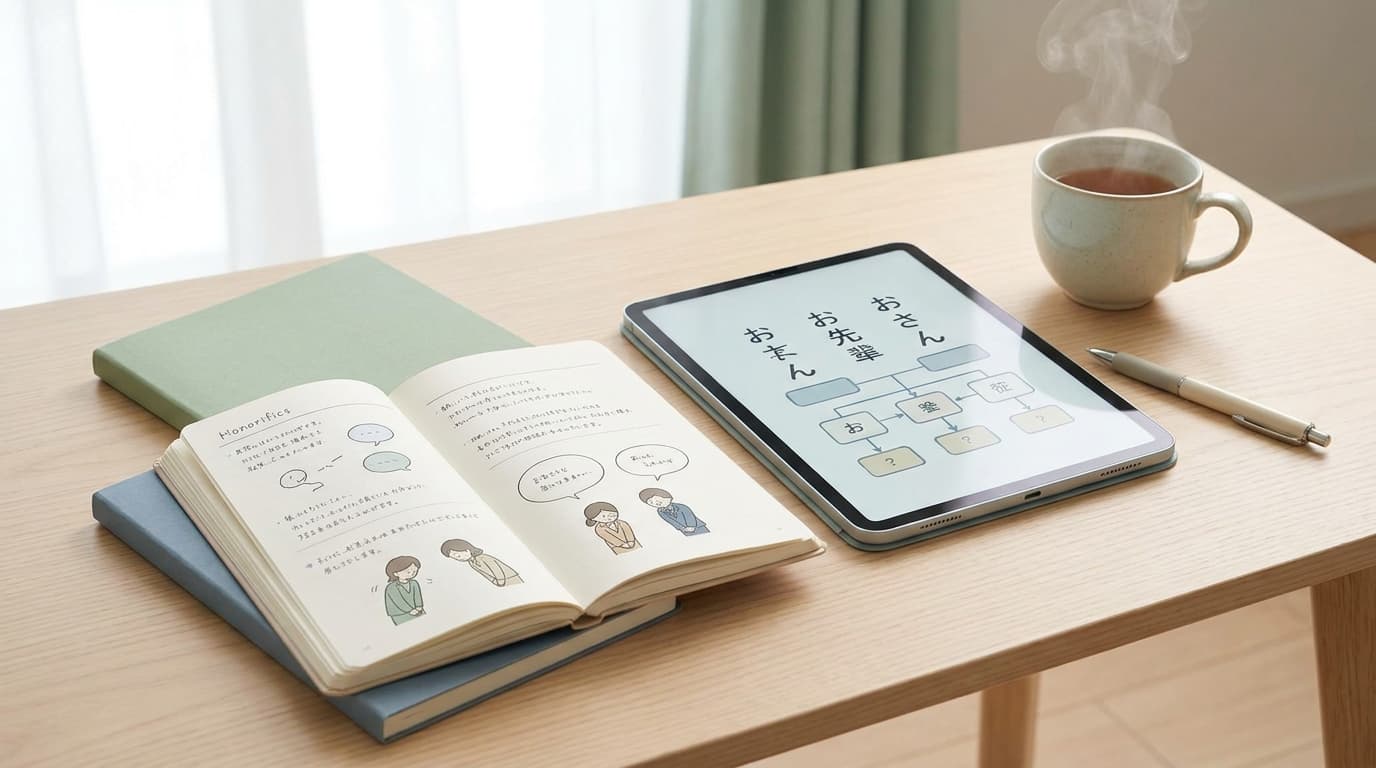
Navigating the complex world of Japanese business etiquette is daunting, especially when it comes to mastering Keigo, the system of honorific speech. By understanding the core distinctions between polite, humble, and respectful language, you can transform your professional interactions from awkward to fluent.
The secret to mastering this nuance isn't just memorizing long lists of grammar rules; it is about hearing these phrases in their natural, professional context. This is where Corodomo becomes your most valuable asset. By using our platform to watch real-life business videos, you can see how native speakers use shigoto (work) related vocabulary while applying Keigo. Corodomo allows you to generate bilingual subtitles instantly, providing you with an AI-powered dictionary lookup for complex honorific verbs so you can focus on the intent behind the words rather than getting lost in the grammar.
- Understanding the Three Types of Keigo
- Sonkeigo: The Art of Respect
- Kenjougo: Mastering Humility
- Teineigo: The Foundation of Politeness
- Practical Tips for Daily Business
- Frequently Asked Questions
Understanding the Three Types of Keigo
Keigo is often misunderstood as a single, rigid set of rules. In reality, it is a three-tiered system designed to show the appropriate social distance between speakers. Understanding this structure is the first step toward professional confidence. Without it, you risk sounding either too casual, which is seen as disrespectful, or overly formal, which can create an unnecessary wall between you and your colleagues.
The three categories are Teineigo (polite language), Sonkeigo (respectful language), and Kenjougo (humble language). Think of these as a map for your social interactions in the office. You use Teineigo with everyone, Sonkeigo to elevate your client or boss, and Kenjougo to lower yourself to show deference. Using Corodomo’s vocabulary tests, you can practice distinguishing between these forms, ensuring that you don't confuse a humble action with a respectful one.
| Japanese | Reading | Meaning |
|---|---|---|
| 敬語 | Keigo | Honorific language |
| 丁寧語 | Teineigo | Polite language |
| 尊敬語 | Sonkeigo | Respectful language |
| 謙譲語 | Kenjougo | Humble language |
Sonkeigo: The Art of Respect
Sonkeigo is used when you are talking about the actions of someone superior to you, such as a client or a manager. The goal here is to elevate the other person. You are essentially putting them on a pedestal. This is the language of customer service and hierarchical respect in Japan.
Many beginners struggle because Sonkeigo often involves changing the verb itself rather than just adding a suffix. For example, the verb "to do" becomes significantly more complex. When you are watching a video on Corodomo, pay close attention to how the speaker refers to their superior’s actions. Using the AI lookup feature, you can instantly clarify why a specific verb form was chosen over the dictionary form.
- Use Sonkeigo for clients, superiors, and guests.
- Focus on the subject of the sentence; if it is the client, use Sonkeigo.
- Practice by creating flashcards for common verbs like "to eat" or "to go."
Original: する (Suru) - To do
Sonkeigo: なさる (Nasaru) - To do (respectful)
Kenjougo: Mastering Humility
Kenjougo is the opposite of Sonkeigo. You use this when describing your own actions or the actions of your company members when speaking to an outsider. It is the language of modesty. By lowering your own status, you show that you hold the listener in high regard.
This is often the most difficult part for English speakers, as it feels counter-intuitive to "devalue" yourself. However, in Japanese business culture, this is a sign of high professionalism. If you are learning about benkyou (study) or self-improvement, remember that applying Kenjougo correctly is a hallmark of a serious learner. You can use Corodomo’s dictation exercises to listen to how professionals humbly describe their contributions to a project.
- Avoid using Kenjougo when talking about yourself to a friend.
- Always use Kenjougo when speaking to a client about your internal team.
- Focus on "lowering" the verb to show your commitment to service.
Teineigo: The Foundation of Politeness
Teineigo is the "safe" version of Japanese. If you are ever unsure which level to use, falling back on Teineigo is your best bet. It is characterized by the endings "desu" and "masu." It is respectful, standard, and appropriate for almost all business situations where you are not specifically required to use the more complex honorifics.
Building a solid foundation in Teineigo allows you to focus on your content without constantly worrying about making a major faux pas. Once you feel comfortable with the "masu" form, you can gradually begin integrating Sonkeigo and Kenjougo. Corodomo helps you bridge this gap by providing leveled vocabulary, allowing you to master basic polite speech before moving on to advanced honorifics.
- Always end your sentences with "desu" or "masu."
- Use "o-" or "go-" prefixes to make nouns more polite.
- Practice by re-writing simple sentences into the polite form.
Practical Tips for Daily Business
The best way to learn Keigo is through immersion. Reading textbooks is helpful, but seeing these phrases used in the wild—in meetings, phone calls, and business presentations—is what makes the knowledge stick. You need to hear the rhythm, the intonation, and the context of these expressions.
Try to watch one short business video daily. Use Corodomo to capture the transcript, then go back and identify the Keigo used. Ask yourself: "Why did they use this form here?" You will start to notice patterns that textbooks simply cannot convey. Consistency is more important than intensity; fifteen minutes of active, video-based listening is far more effective than an hour of passive reading.
- Keep a list of "Must-Know" business verbs on your desk.
- Use Corodomo’s AI Q&A to ask about specific honorific phrasing in a video.
- Record yourself speaking and compare your intonation to the video.
Frequently Asked Questions
Is it possible to be too polite in Japanese business?
Yes, "double keigo" (nijuu keigo) can occur, where you use multiple honorifics on one verb, making it sound cluttered and unnatural. It is better to be correctly polite than excessively complex.
Should I use Keigo with coworkers?
It depends on your relationship. Typically, you use Keigo with superiors, but you might use plain or polite forms with close colleagues. Always observe how your team communicates with each other.
How can I practice Keigo if I don't have Japanese coworkers?
Use video-based learning platforms like Corodomo to watch real business scenarios. You can mirror the speakers and use AI tools to check if your sentence construction is appropriate.
Is Kenjougo only for written communication?
No, it is essential in verbal communication, especially when speaking to clients on the phone or in meetings. It is a vital tool for showing professionalism in real-time interactions.
Conclusion
Mastering Business Keigo is a journey that requires patience, active listening, and consistent practice. By focusing on these three key takeaways, you will build the professional confidence needed to navigate the Japanese workplace:
- Distinguish the roles: Remember that Sonkeigo elevates the other person, while Kenjougo lowers yourself.
- Build a foundation: Master Teineigo first, as it is the standard for professional, polite communication.
- Immerse yourself: Use real-world video content to hear how native speakers apply these rules in authentic business contexts.
Try Corodomo: Learn languages · Learn via Video · Exam practice